Customer says you sent the wrong item: how to prove which unit went in the box

On this page
This is written for the seller side: how to tell the four claims apart, what evidence each one needs, and how to answer the platform without overclaiming. If you have not yet settled on how you record orders in the first place, start with what makes a packing video count as evidence — everything below assumes that baseline. For the category itself, and why a recording is not the same thing as proof, see packing video proof.
The four claims that look the same and are not
| The buyer says | The real question | What answers it |
|---|---|---|
| "You sent a completely different product" | Which SKU went into this order | Order identifier and product in one frame; barcode scan |
| "Right product, wrong size/colour" | Which variant went into this order | The size or colour label legible next to the order number |
| "One item is missing" | How many units went into this box | A count visible in a single unbroken take |
| "It isn't the authentic one" | Which specific unit went into this order | Serial number, IMEI or another unique marker recorded at packing |
Answering the wrong question is how sellers lose cases they should win. A photograph of a pristine hoodie does nothing against "you sent size M, I ordered L". If the claim is that the entire box arrived empty rather than one item missing from a larger order, that is its own harder case: see proving what you shipped when the box was empty.
Why your usual evidence fails here
Tracking proves a parcel moved and was delivered. It says nothing about contents.
The invoice and packing slip prove what was ordered. Nobody disputes that; the claim is that something else was put in the box.
The listing photo shows a unit, not the unit. It cannot distinguish yours from any other of the same SKU.
Your pick-and-pack log is a record you generated about yourself. Reviewers discount self-reported internal data, exactly as they would discount a buyer's word alone.
Weight at the label is closer: it distinguishes an empty box from a full one, but not two variants of the same garment.
The four identifiers that settle it
Not all of them apply to every product. Use the ones that do.
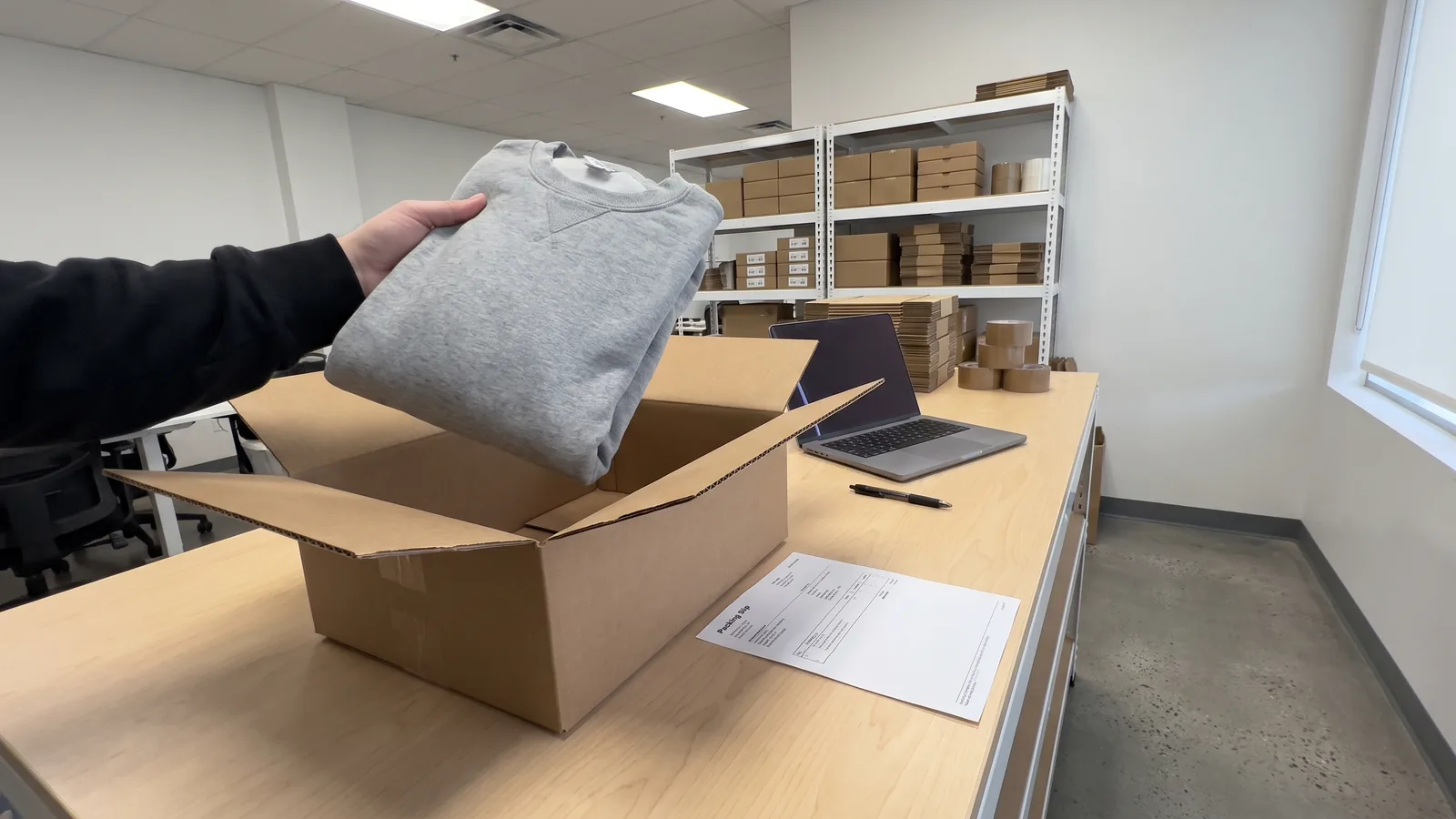
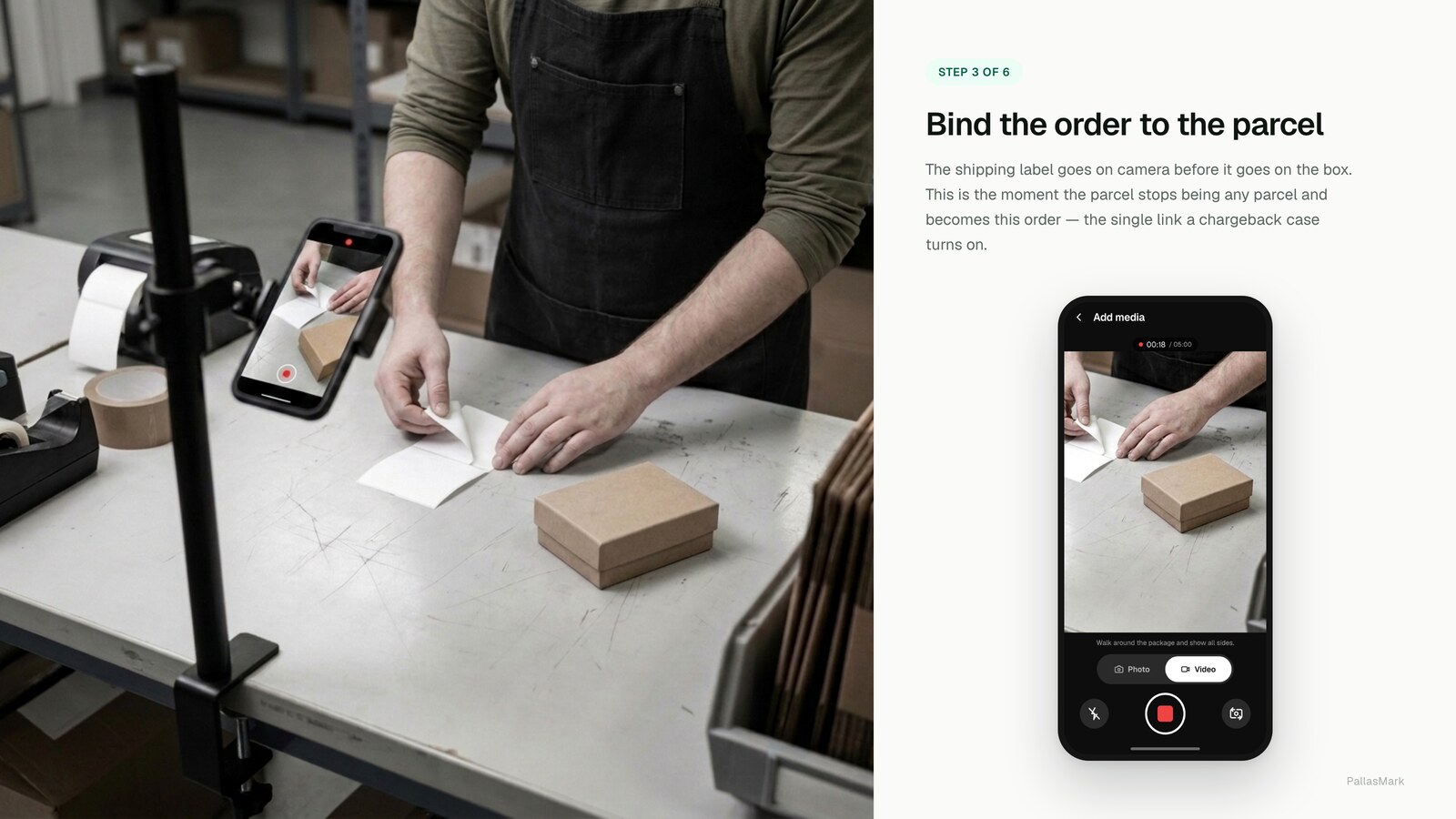
The order identifier, in frame with the item. A barcode on the packing slip, scanned or held next to the product. This alone answers the first claim in the table.
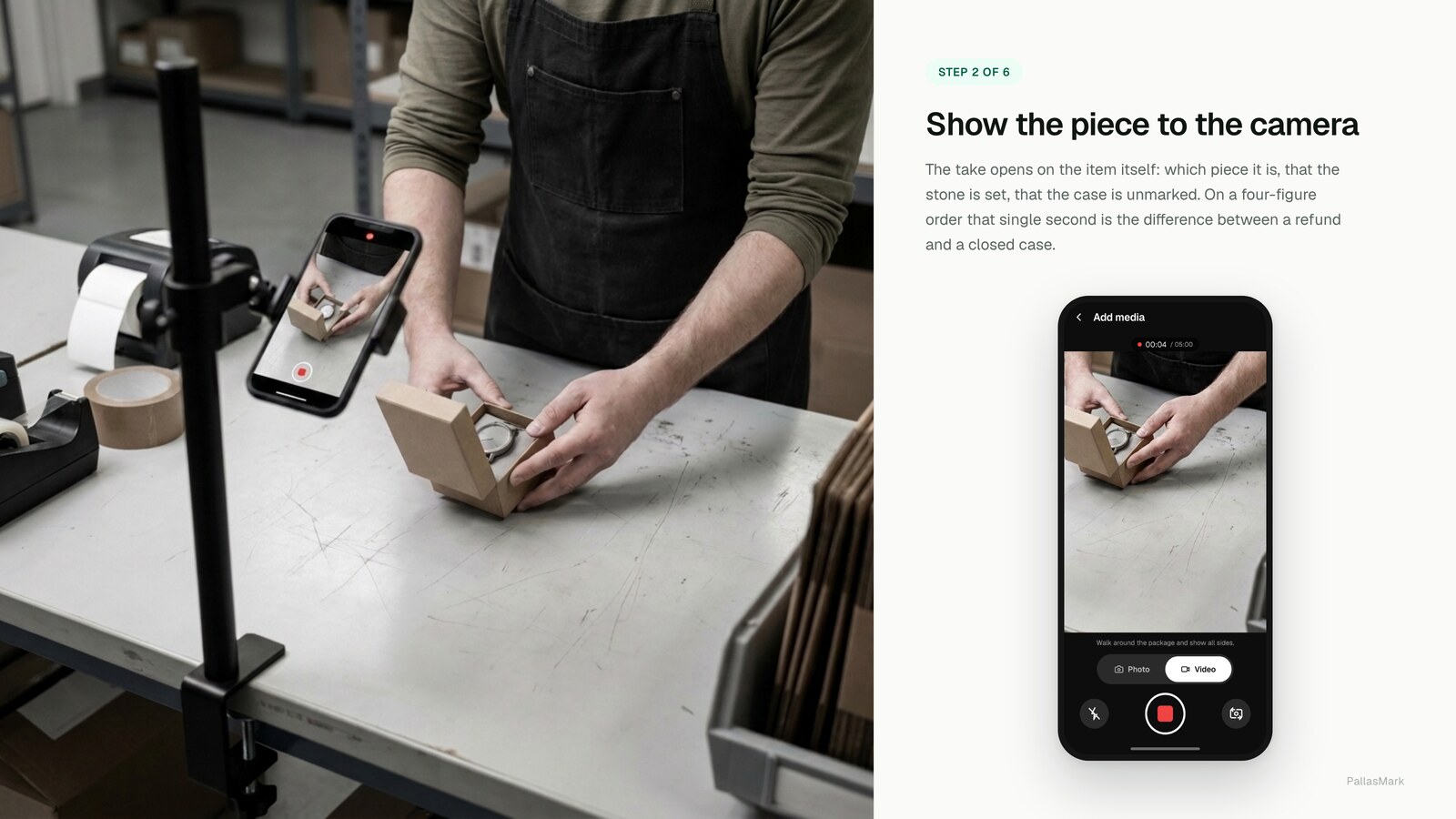
The SKU or barcode of the product itself. Scanning it at pack time ties the physical unit to the catalogue entry rather than to your memory.
The variant marker. Size labels, care tags, colour under neutral light. This is the one sellers skip, and it is the one that decides the most disputes, because variant claims are the hardest to disprove after the fact.
The unique marker. Serial number, IMEI, batch code, hallmark. Only this can distinguish your unit from an identical one, which is why it also answers the return-swap version of the claim, where the buyer returns a different unit of the same product. If your goods carry serials and you are not recording them, that is the single highest-value change available to you. It is the same evidence that answers authenticity and warranty claims.
Serialised versus unserialised goods
The identifiers above do not all carry the same weight, and knowing which tier your product sits in changes what you should expect from a dispute.
| Tier | Examples | What you can prove | What you cannot |
|---|---|---|---|
| Serialised | Electronics, watches, appliances | Exactly which physical unit shipped and which one came back | Nothing extra needed — the serial does the work |
| Batch-coded | Cosmetics, supplements, some apparel | Which production run shipped | Which individual unit within that batch |
| Variant-only | Clothing sizes/colours, most homeware | Which SKU and variant shipped | Two identical units of the same variant apart |
| Fully generic | Unbranded, commodity goods | That a correct-looking unit shipped | A return-swap claim, ever |
If your catalogue sits in the bottom two rows, the honest answer to "did they swap it?" is that you often cannot prove it from a serial number alone, order-to-unit identity is the strongest evidence available, and it is worth being precise with the platform about which claim you are actually contesting.
Where each platform looks
The claim reaches you through one of these, and each weighs evidence slightly differently.
| Platform | How it arrives | What actually moves it |
|---|---|---|
| eBay | Return request ("doesn't match description") or payment dispute | Pre-shipment evidence plus the listing as it stood on the order date |
| Amazon | A-to-z claim, or a return with a mismatch reason | Documented dispatch condition and identifiers; buyer messages kept in Seller Central |
| Shopify | Chargeback through the payment provider | One evidence upload, usually one chance; assemble everything before submitting |
| PayPal | Item Not As Described case | Proof of what shipped plus delivery confirmation |
| Etsy | Case in the Resolution Centre | Order photos and on-platform messages |
Where it goes wrong inside your own operation
Not every wrong-item claim is fraud. Before contesting one, it is worth knowing what your own error rate is, because the answer changes what you should do.
Three patterns cause most genuine mis-picks:
- Adjacent bins with similar SKUs. Two variants of the same product stored next to each other produce a steady trickle of swaps.
- Multi-item orders picked in one pass. The second and third items are where counts go wrong.
- Restocked returns going back into the wrong location, which then ships to the next buyer.
A record of each pack doubles as the audit trail that tells you which of these you have. That is the packing quality side of the same recording: contest the claims that are wrong, and fix the process that produces the ones that are right.
Reducing how often this happens
Evidence wins the disputes you already have. These reduce how many you get in the first place.
None of these need new software to start; the highest-value one is usually the first, because it is the same discipline that produces your dispute evidence and your fraud-detection data at once.
How to respond, step by step
Your evidence pack
Response templates
Keep every message on the platform's own record.
That last framing matters. Disputing everything reads as obstruction; disputing the one fact your evidence establishes reads as credible.
Six mistakes that lose a winnable case
Terms you will see
- SNAD / INAD — "Significantly Not As Described" / "Item Not As Described", the dispute category most wrong-item claims arrive under.
- Return swap — the buyer returns a different unit, or a different product, from the one shipped.
- Variant mismatch — right product, wrong size or colour; the hardest version to disprove from photographs.
- Short shipment — a multi-item order arriving with fewer units than ordered.
- Serialised goods — products carrying a unique per-unit marker, which is what makes a return swap provable.
What this does not fix
An order-to-unit record cannot distinguish your unit from another identical one unless the product carries a unique marker; say that plainly rather than overclaiming. It does not decide cases where the listing itself was ambiguous about the variant. And it is no answer at all when the dispute is really about whether the cardholder authorised the purchase, which is a different question with different evidence.
What it does is close the gap that makes this claim profitable: the fact that, after the box is sealed, nobody can show which unit was inside it.
Where PallasMark fits
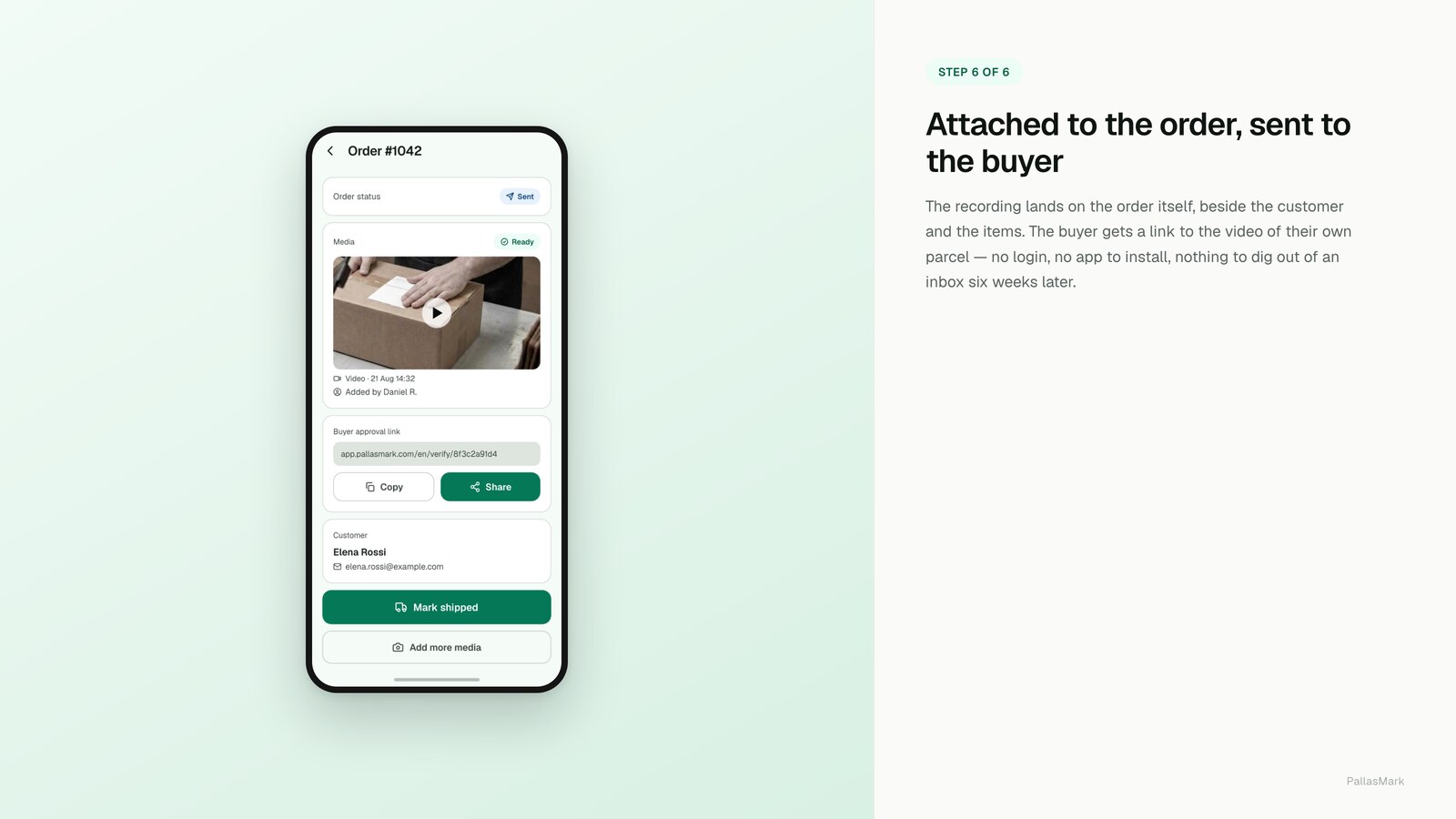
PallasMark ties the recording to the order it belongs to: scan the order or product barcode to open it, record the unit, labels and serial as it is packed, and the file is sealed at capture so any later edit is detectable. The result is a link a buyer, a marketplace agent or a bank can open and verify without an account. The same record covers packing accuracy, authenticity claims and short-shipment disputes on multi-item orders. If the claim you get most often is about condition rather than identity, start with proving an item left you intact instead.
Frequently asked questions
What evidence do platforms accept for a wrong-item claim?
Evidence that ties the specific order to the specific unit you shipped: an order identifier and the product visible together, a scanned SKU or barcode, a readable serial number, and the listing as it stood on the order date. eBay's own seller-protection guidance lists photographs showing the item's condition prior to shipment among the evidence it will consider; the same principle applies across marketplaces and card schemes.
The buyer sent back a different unit from the one I shipped. How do I prove that?
With a serial number, IMEI or another unique marker recorded at packing and checked on return. Without a unique marker there is no way to distinguish your unit from an identical one, which is exactly why return swapping targets products that have no serials.
They claim the wrong variant: colour or size. Is that different?
It is the hardest version, because both units look the same in a photograph. What settles it is a frame where the size or colour label is legible next to the order number, or a barcode scan of the exact variant. Photograph the label, not the garment.
Can I refuse the return if I know I shipped the right item?
You can contest the claim, and evidence is what makes contesting worth the effort. Marketplaces default to the buyer when the seller offers only an assertion. A record that identifies the unit turns the case from your word against theirs into a factual comparison.
Does a packing video help if the item has no serial number?
Yes, for order-to-unit identity: it shows that this SKU and variant went into this order's box. It cannot distinguish your unit from another identical unit, so it will not by itself prove a return swap on unserialised goods. Be precise about which of the two you are claiming.
What if it really was our mistake?
Fix it fast and use the record to find out why. A recording of every pack is also an audit trail: it shows whether the picker grabbed the wrong bin, whether two similar SKUs sit next to each other, and which orders need re-checking before those buyers get in touch.
How fast do I need to respond once a wrong-item claim is opened?
Faster than feels necessary. Most platforms start a response clock the moment the claim opens, and a case that times out is usually decided for the buyer regardless of what evidence you eventually had. Reply within the platform's window even if all you can say at first is that you are pulling the order record.
- wrong item
- disputes
- evidence
- packing accuracy