How to prove an item was shipped correctly: what PayPal, eBay, Amazon, Etsy, Shopify and Stripe actually look at

On this page
"How do I prove I shipped the right item?" is one of the most common questions sellers ask after their first not-as-described claim, and the search results for it are mostly platform help pages that each answer a slightly different question. PayPal tells you what counts as proof of shipment. eBay tells you what to upload in a dispute. Stripe tells you how to format a PDF. None of them tells you what to collect at the bench so you have something to upload.
This guide puts those rules side by side, with links to each platform's own pages, and turns them into a checklist. It is written for sellers handling claims themselves. Policies change, so treat the links as the source of truth and our summaries as a map. We last checked them in October 2026.
Proof of shipment is not proof of contents
Most "proof" advice online is about proof of shipment: a tracking number, a carrier receipt, a delivery scan. That matters, but it answers a different claim.
| The buyer says | What they are really disputing | Evidence that answers it |
|---|---|---|
| "It never arrived" | Delivery | Carrier tracking, delivery confirmation to the address on the order, signature for high-value orders |
| "It was the wrong item / size / colour" | Contents | Pre-shipment record of the item and its label, serial or variant identifier, the listing as sold |
| "Something was missing" | Contents | Pre-shipment record showing each item going in, sealed weight |
| "The box was empty" | Contents | Pre-shipment record through sealing, sealed weight, carrier scan weight |
| "It isn't as described / it's damaged" | Condition and accuracy | Listing as it stood, pre-shipment photos or video of condition, packaging used |
If you answer a contents claim with tracking, you have answered a question nobody asked. That is the most common way sellers lose cases they could have won. For the specific claims, we have separate guides: wrong item sent, box was empty and arrived damaged.
What each platform actually weighs
PayPal
PayPal's Seller Protection covers two things: Item Not Received claims filed through PayPal's Resolution Center, and eligible unauthorised payments. To qualify for physical goods, you must ship to the address on the Transaction Details page, respond to PayPal's requests for documents on time and provide proof of shipment or delivery.
The same page lists Significantly Not As Described claims as excluded. That is the single most important fact for this topic: if a PayPal buyer says the item was wrong or not as described, Seller Protection does not apply, and the case is decided on the evidence both sides provide.
For proof of shipment, PayPal's help article asks for shipping documentation from the carrier showing the recipient's name and address as they appear on the Transaction Details page. Signature confirmation was required for transactions over $750 processed before 26 January 2026; for later transactions PayPal says it is no longer required but still recommends it. If a buyer asks you to ship somewhere else, PayPal suggests refunding and having them pay again to the correct address, which tells you how much weight it puts on that address match.
What this means in practice: tracking with a matching address protects you on non-delivery. For contents claims, you need your own record of what went in the box.
eBay
eBay's Money Back Guarantee policy lets buyers return an item that does not match the listing for a refund, even if the seller does not accept returns. For not-as-described items the seller pays return shipping, must respond within 3 business days and must refund within 2 business days of receiving the return. eBay may review a request first and decline it if the evidence does not support the claim.
The policy also includes protections that only work if you have evidence:
- Returning a different item than the one sent is treated as fraudulent, and the buyer can lose coverage.
- Using or damaging an item and then returning it is treated as abusive buyer behaviour, and eBay may suspend the buyer's coverage.
- If an item comes back used or damaged beyond what was needed to check it, some sellers may deduct the loss in value from the refund.
- Sellers can appeal a decision within 30 calendar days.
eBay's help page on handling payment disputes is more specific about evidence: for a not-as-described or damaged claim it suggests a clear photo showing the item as described and its condition before shipping, along with messages showing your attempts to resolve the issue; for a different item coming back, proof that a different item or one in a different condition was returned. At the time of writing, the upload form took JPEG, JPG or PNG images, up to five files under 1.75 MB in total.
What this means in practice: eBay explicitly asks for pre-shipping condition evidence, and its image-only upload limit means a video has to become a few clear stills.
Amazon (A-to-z Guarantee)
Amazon's A-to-z Guarantee page covers buyers of items sold by third-party sellers, including items that arrive damaged, defective or materially different from what was ordered, within a time limit measured from the latest delivery date. Amazon makes the decision; you contribute information.
In Seller Central, Amazon's claims help page says that if a seller does not respond to a request for more information within 72 hours, Amazon grants the claim and debits the seller. The response itself happens through the claim screen under Performance, so check the page and the deadline on the claim in your own account, which is behind a login.
What this means in practice: the window is short, and you will not have time to reconstruct evidence. Whatever you are going to submit has to exist the moment the claim lands.
Etsy
Etsy's Purchase Protection covers buyers whose item differs from the listing or photos, arrives damaged, arrives at least 7 days late or never arrives. Buyers must first message the seller through "Help with order" and can open a case 48 hours later. Etsy's seller-side help describes the program as covering qualifying orders up to $250, in which case Etsy may refund the buyer and the seller keeps their earnings, provided conditions such as an accurate listing and a shop in good standing are met. For cases that are not covered, Etsy's guide to resolving a case from a buyer explains how to respond.
What this means in practice: listing accuracy is the threshold question. Accurate photos plus a record that the item you shipped matches them are what your response rests on.
Shopify (chargebacks)
On Shopify, a contents dispute that reaches the buyer's bank becomes a chargeback. Shopify's chargeback instructions are strict about format: only PDF, JPEG or PNG; each file no more than 2 MB and all files together no more than 4 MB; each PDF under 50 pages; and do not include audio or video files, links to external resources, or requests to call or email. Its general guidance notes that with Shopify Payments, order details such as product details, addresses and shipping and tracking information are included automatically, and that images should be high-contrast because many banks receive evidence by fax.
What this means in practice: your packing record has to arrive as images or a PDF. A link to a video will not be followed.
Stripe (disputes)
Stripe's dispute evidence best practices ask for proof of shipment and delivery with the full delivery address for physical goods, a description of the product as presented at purchase, relevant customer messages, and evidence organised chronologically with a short summary of what each item shows. Formats are PDF, JPEG or PNG, with a combined limit of 4.5 MB and fewer than 50 pages (19 for Mastercard), and Stripe advises against pointing to content hosted on other drives or websites. Stripe is also candid that disputes are hard to overturn even with good evidence.
What this means in practice: concise, chronological, readable. A PDF with a few well-chosen stills and a one-paragraph explanation beats a long folder of everything.
At a glance
| Platform | Not-as-described covered for the seller? | What the seller is asked for | Video accepted directly? |
|---|---|---|---|
| PayPal | No, SNAD is excluded from Seller Protection | Proof of shipment/delivery to the address on the transaction | Not addressed for SNAD; plan for documents |
| eBay | Returns allowed; protections for different or damaged returns | Pre-shipping condition photos, messages | Payment dispute uploads: images only |
| Amazon | Amazon decides A-to-z claims | Information on request, within 72 hours | Check the claim form |
| Etsy | Purchase Protection for qualifying orders up to $250 | Accurate listing, case response | Check the case form |
| Shopify chargebacks | Bank decides | PDF/JPEG/PNG, within size limits | No: no video files or external links |
| Stripe disputes | Bank decides | Proof of delivery, product description, chronology | No: PDF/JPEG/PNG only |
The evidence checklist
Every item below covers a gap the others leave open. You will rarely have all of them for every order; the point is to know which ones matter for which claim.
Two notes on that list. First, continuity matters more than resolution. A single unbroken recording from order reference to sealed box is much more persuasive than three sharp photos, because it leaves no gap in which something could have changed. Second, timestamps from a system count for more than a date you typed. A file uploaded to a system that logged when it arrived, against which order, is a record. A file named order-1234.mp4 on a laptop is a claim. The capture standard is covered in depth in what makes a packing video count as evidence.
Where a packing video helps, and where it does not
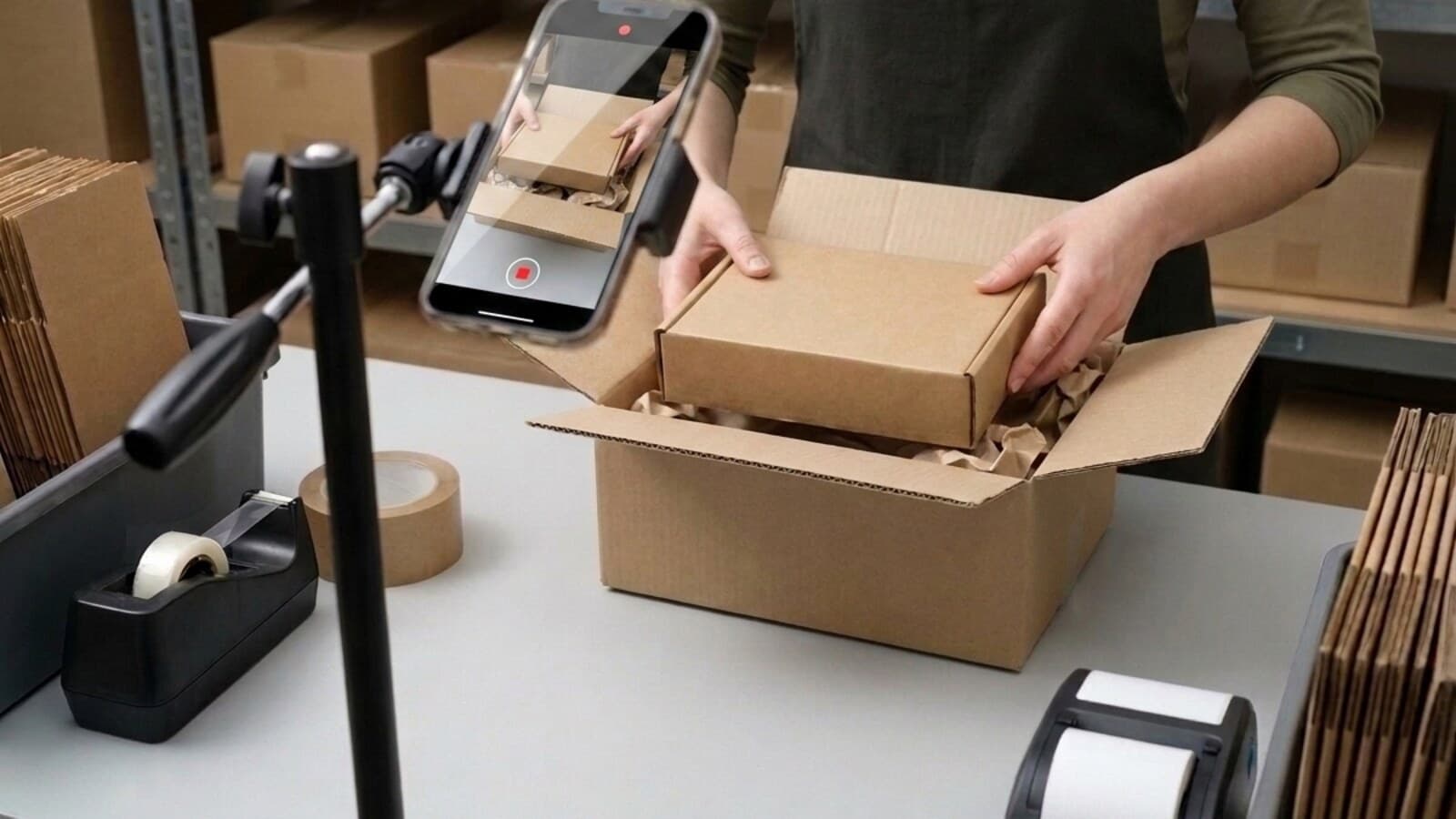
A packing recording is the only common form of evidence created at the moment most contents claims are about: when the item went into the box. That makes it unusually useful for:
- Wrong item, size or colour. The recording shows the label or variant going in.
- Missing items. Each unit visibly entering the carton.
- Empty box. The item going in and the box sealed without a cut.
- "Different item returned." If the serial number was on camera, you can compare it with what came back.
- Condition disputes. The item's state immediately before shipping.
It is weak or irrelevant for:
- Non-delivery. The recording ends at the bench. Tracking and delivery confirmation answer this claim.
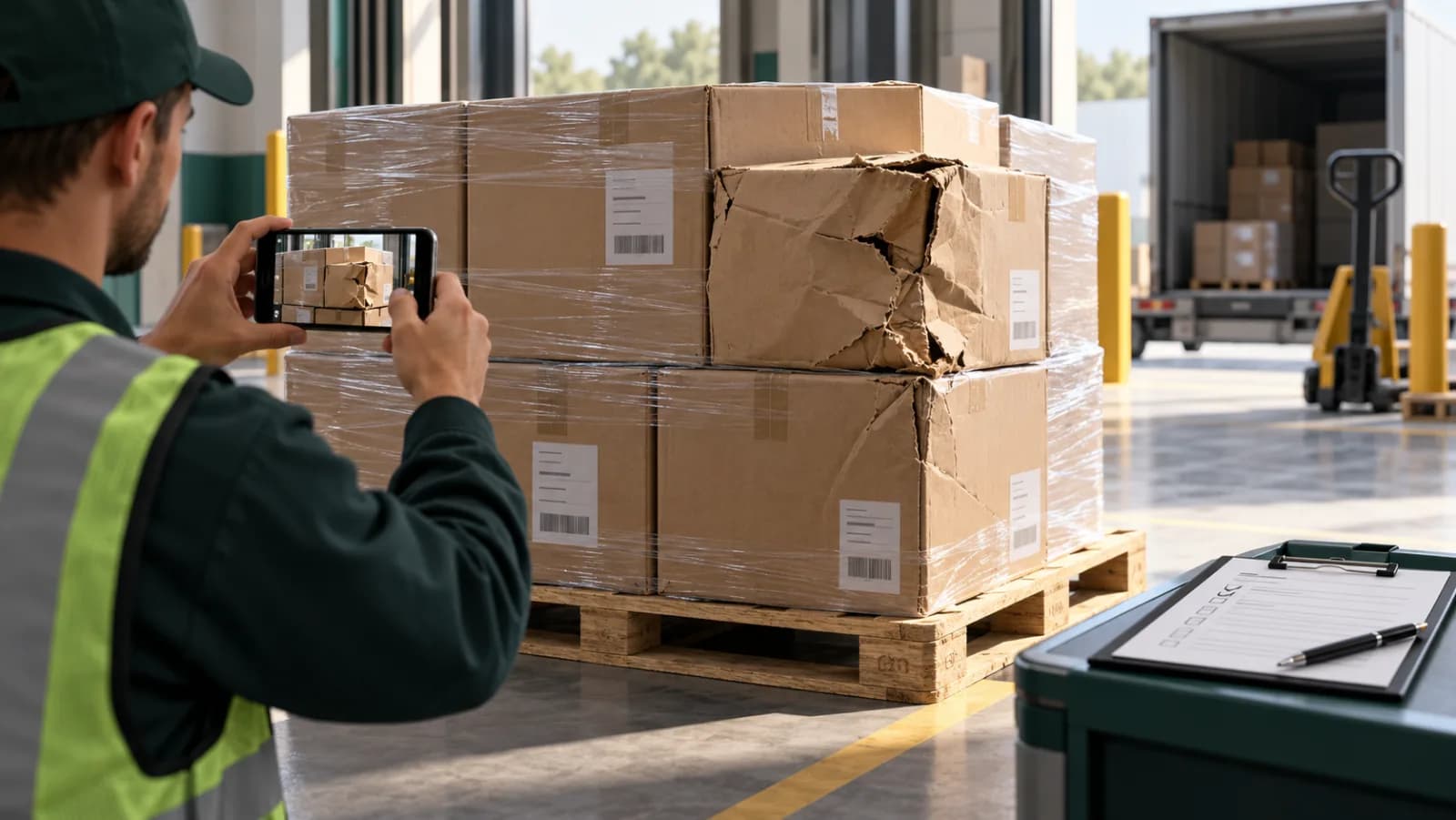
- Damage in transit. It shows the item left intact and packed properly, which matters, but not what happened in the carrier's network.
- Fraud and unauthorised payments. These ask who made the payment, not what was shipped. See which disputes packing video can support.
- Formats that do not take video. Card disputes and some marketplace forms accept images only. A recording you cannot turn into clear stills is hard to use there.
Buyer approval: evidence the buyer created
There is one kind of evidence that tends to end arguments rather than win them: the buyer's own confirmation. If, before the parcel ships, the buyer receives a link to the packing record for their order and confirms that what they see is what they ordered, a later "wrong item" claim has to contradict the buyer's own approval.
This is not standard on any of the platforms above, and it will not suit every product. It matters most for custom, made-to-order, high-value or easily confused items, where the most likely dispute is "this isn't what I ordered."
Turning the record into something you can submit
Because so many forms take images or PDFs only, the last step is translation:
Keep the tone factual. You were not there when the parcel was opened, so do not argue about what the buyer found. Argue about what you shipped, with the one record you have of that moment.
How PallasMark fits
PallasMark is a tool for building the record described above, not for filing cases. In short:
- Per-order recording. Packers record video or photos for each order from the PallasMark phone app (iOS and Android) or the web, and the files attach to that order. Orders come in from the Shopify app or the WooCommerce plugin.
- A fingerprint at upload. Each file gets a SHA-256 fingerprint when it is stored, and anyone holding the file can check it on a public verification page. How verification works explains what that check does and does not prove.
- Buyer approval. You can send the buyer a link to the packing record so they confirm what is being shipped before it goes.
- An evidence dossier on request. From the order page you can generate a PDF (with four stills from each video, for forms that do not take video) and a time-limited link. You submit them yourself; PallasMark does not file cases or submit to any platform or payment provider for you.
Plans are Free, Pro at $348 a year and Business at $1,188 a year, billed annually. See pricing for current limits, or packing video proof for how the recording itself works.
What this does not fix
No combination of evidence guarantees a platform will side with you; each one makes its own decision under its own rules, and some lean towards the buyer by design. Evidence also does not replace an accurate listing: if the photos and description overstate the item, a perfect packing record just proves you shipped something that did not match. And none of this replaces prompt, polite communication. Many contents claims are genuine mistakes on one side or the other, and a fast, fair resolution often costs less than winning.
What a good record does is change the conversation from "your word against theirs" to "here is what was shipped." That is usually enough to resolve the honest cases quickly, and it is the only foundation you have for contesting the rest.
Frequently asked questions
How do I prove what was in a package I shipped?
Nothing proves it perfectly, but a combination comes close: a recording or timestamped photos that show the order reference and each item going into the box before it is sealed, a serial number or variant label where the product has one, the sealed parcel's weight, tracking to the address on the order, and ideally the buyer's own confirmation of the packing record. Each piece covers a gap the others leave.
Does PayPal Seller Protection cover 'not as described' claims?
No. PayPal's Seller Protection pages list Significantly Not As Described claims as excluded. Seller Protection covers Item Not Received claims filed through PayPal's Resolution Center and eligible unauthorised payments, and it requires proof of shipment or delivery to the address on the Transaction Details page. For not-as-described cases, your own evidence of what you shipped is what you have.
Is tracking enough to prove I shipped the right item?
No. Tracking shows that a parcel moved and, with delivery confirmation, where it ended up. It says nothing about what was inside. It is essential for item-not-received claims and almost irrelevant to a wrong-item or not-as-described claim, unless you pair it with weight or contents evidence.
Will a packing video win an eBay or Amazon case?
No single piece of evidence guarantees an outcome; the platform decides. A packing recording is useful because it shows the item and its condition before shipping, which eBay explicitly asks for in payment disputes. But some upload forms accept only images, so you may need to submit stills. Check the current rules of the case you are answering.
What is the best evidence against a buyer who returns a different item?
A record of a unique identifier on the item you shipped, such as a serial number, IMEI or batch code, captured on camera or photographed before sealing. eBay's policy treats returning a different item as fraudulent. Without a unique identifier, you are comparing two similar items with nothing to tell them apart.
Can I send a video link in a Shopify or Stripe chargeback?
Generally no. Shopify's chargeback instructions say not to include video files or links to external resources and accept only PDF, JPEG or PNG. Stripe also accepts only those formats and advises against linking to content elsewhere. Use stills from the recording inside a PDF instead.
- proof of contents
- item not as described
- seller protection
- disputes
- packing video
- evidence