Part of the Returns and refund fraud guide
Return swap fraud: how to prove which serial number you shipped

On this page
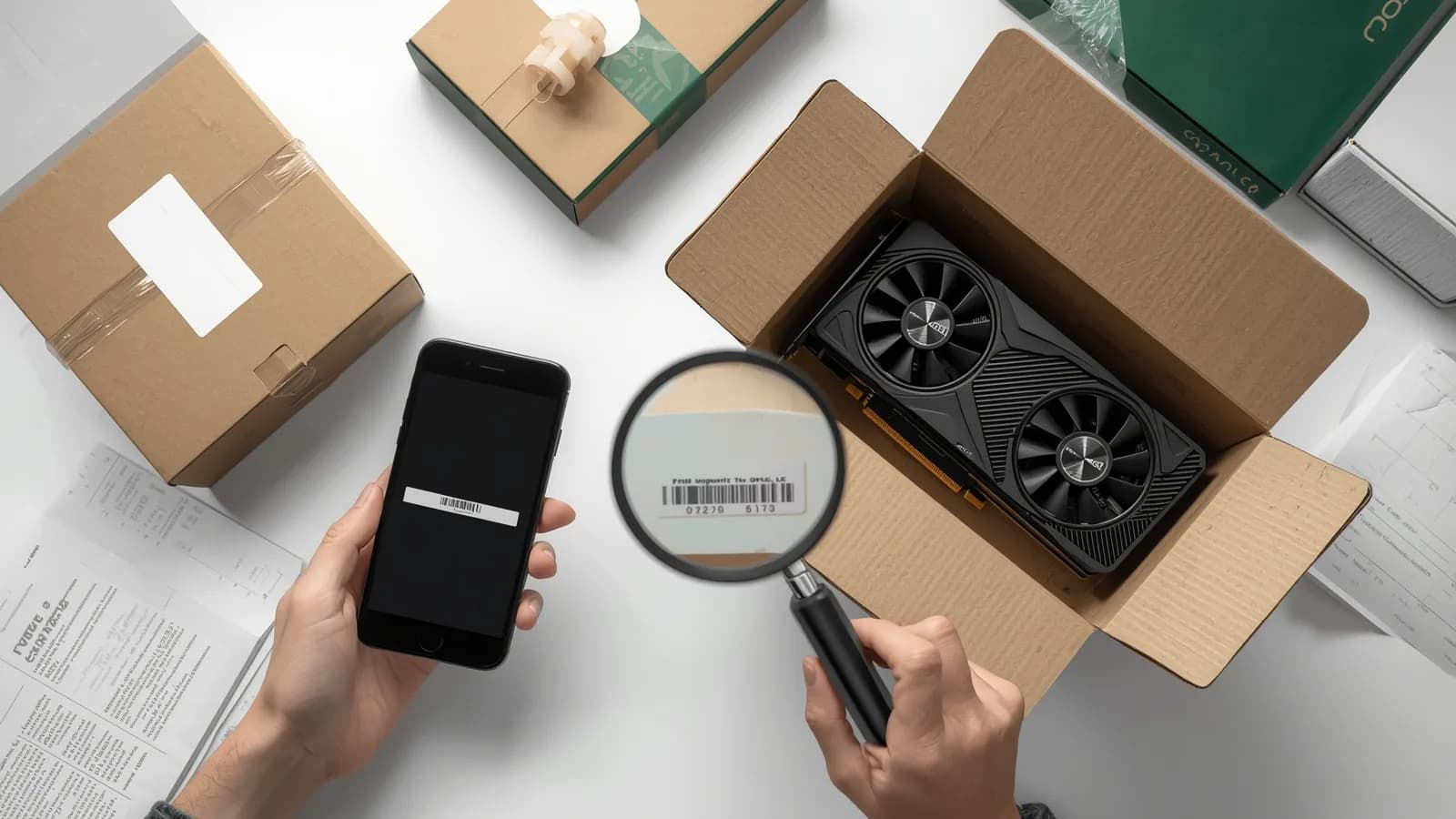
A return comes back for a $700 graphics card. The box is right, the seal looks fine, the weight is close. Inside is a card of the same model with a different serial, a dead fan and a cracked bracket. Or there is no card at all. This guide is about proving that, and about setting up the records before it happens. It covers the return side of the problem; for proving which unit went out in a "you sent the wrong item" claim, see customer says you sent the wrong item.
It is part of our return fraud evidence playbook.
What return swap fraud looks like in 2026
Return swap fraud replaces the unit you shipped with something cheaper before sending it back for a refund. The swapped item is chosen to pass a quick look: the same model in worse condition, a counterfeit, a lower-spec variant, or junk weighted to match.
The best-known recent case did not even reach the original seller. In June 2026, Tom's Hardware reported that a PC builder who ordered an RTX 5070 from Amazon, a card of roughly $700, opened the box to find a DVD rewriter and a logic board from an early-2000s AV receiver. The most likely explanation is an earlier buyer's swapped return that passed inspection and went back into stock. The swap cost three parties: the merchant who refunded, the next buyer, and the brand's reputation.
Swaps sit inside a larger category. In the Merchant Risk Council's 2026 report, as summarized by Chargeback Gurus, returns of used or damaged goods were the second most common form of refund and policy abuse, cited by 44% of merchants.
| Swap type | What comes back | What exposes it |
|---|---|---|
| Same model, older unit | The buyer's own worn or broken unit | Serial or IMEI differs from the dispatch record |
| Counterfeit | A fake of the branded product | Serial format, hologram, weight, build details |
| Lower variant | Smaller storage, older revision, cheaper colorway | Model number or variant label on the unit |
| Parts swap | Your unit with key parts removed or replaced | Internal serials, tamper seals over screws, accessory list |
| Junk of similar weight | E-waste, bricks, filler | The return opened on camera; weight compared with outbound |
What a reviewer needs to see
A reviewer can act on a swap only when it is a factual mismatch between two records, not a disagreement about condition. The question they are asking is simple: is the unit that came back the unit that went out?
That needs three things, and sellers usually have only one:
- A dispatch record where the serial or IMEI is legible next to the order reference, made before the carton was sealed.
- A return-opening record where the return label and the returned unit's serial are visible, made before anyone handled the unit.
- A statement of the mismatch in one sentence: serial A shipped, serial B came back.
Most sellers have the second one, taken after the return has sat in a bin for a few days. Without the first, the reviewer cannot exclude the explanation they would otherwise assume: that you shipped serial B. ShipAid's September 2026 guidance on refurbished electronics makes the same point from the returns side: verify the returned unit against the specific serial or IMEI that shipped, not just the model.
Where you contest a swapped return
You contest a swapped return through the channel the order came from: the eBay return case, an Amazon SAFE-T claim, Back Market's review of a disputed claim, or your own return decision. Each has its own window, so check the platform's current rules before you act, especially before you refund on your own.
| Channel | Where the swap is contested | What to attach | Rule worth knowing |
|---|---|---|---|
| eBay | The return case, plus reporting the buyer | Dispatch serial record, return-opening record, one-line mismatch statement | Per eBay's seller protections, Top Rated Sellers offering 30-day or longer returns can deduct up to 50% for items returned used or damaged, and lose that option once eBay is asked to step in |
| Amazon (seller-fulfilled) | A SAFE-T claim in Seller Central | The same pack | Read the SAFE-T eligibility rules and filing window in Seller Central before refunding yourself |
| Back Market | Disputing the buyer's claim; Back Market reviews | The same pack, with IMEI or serial frames | Back Market asks buyers for photos from multiple angles and to report damage within three business days, so your dispatch record is what their photos are compared against |
| Your own store | Your return decision, then any chargeback | The evidence dossier as a PDF | Card disputes run on documents; see chargeback evidence |
How to set up serial number evidence, step by step
The procedure has two halves: capture at dispatch and comparison at return. Neither works without the other.
What to capture at dispatch
What to capture when the return arrives
Copy-ready templates
Keep the tone factual. You are not proving the buyer is dishonest; you are showing that two serial numbers differ.
How PallasMark handles this
PallasMark covers both capture points and the comparison between them, on the phones your team already uses, with no fixed camera stations.
Dispatch records with the serial in frame. Scan the order barcode and the app opens that order, so the recording is bound to it before the first frame. Hold the serial label next to the packing slip and it is in the same record as the order reference. Photos are stamped with your company name, the order number and the upload time inside the image file. Every stored file gets a SHA-256 fingerprint, and a public verification page re-hashes it on demand so a marketplace agent can check it with no account. See tamper-proof video.
Serials as searchable data. Define custom fields such as a serial number or IMEI on your records, then search and filter by them later. On the Scale plan, AI label reading fills those fields from a photo of the label into an editable form the operator checks before saving; a scanned barcode always wins over the AI reading. More on that in AI label reading for serial numbers.
The buyer's footage before the label. When a buyer opens a Shopify or ShipHero return, PallasMark automatically sends them a link to film or photograph the unit and its packaging, you choose which return reasons trigger it, such as defective or not as described, and whether the evidence is optional or required. WooCommerce orders get a one-tap request, and any open return can be requested from the Returns page. See return evidence.
Returns opened on camera at the warehouse. Record the return opening as a warehouse receiving record, tied to a facility and, for 3PLs, a client brand, with the order or return tracking number as the reference. Share that single record with a client brand, carrier or supplier through a link with an expiry and an optional PIN. See warehouse proof.
One appeal file. On request, PallasMark builds an evidence dossier PDF for the order, with four stills from each recorded video, the photos, the fingerprints and the return evidence, ready for you to upload to eBay, Amazon, Back Market or a payment provider. Start on the free plan with no card, or see pricing.
Related reading
Swaps are one of nine claim types in the return fraud evidence playbook. If the "damage" on a returned unit arrives as a suspiciously perfect photo rather than a parcel, see AI-generated damage photos in refund claims. Organized swap and empty-return schemes sold by paid refunders are covered in refund fraud as a service, and refurbished sellers will find grading-specific advice in refurbished electronics dispute evidence.
Frequently asked questions
What is return swap fraud?
Return swap fraud, also called a switcheroo, is when a buyer keeps the item they received and returns something else in its place: an older or broken unit of the same model, a counterfeit, a cheaper variant or a box of junk of similar weight. It targets products that look alike from the outside, especially electronics, tools and branded goods, because the swap is invisible until someone checks a unique identifier.
How do I prove a buyer returned a different item?
Show that the serial number, IMEI or another unique marker on the returned unit differs from the one recorded on the unit you shipped. That needs two records: one made at dispatch, with the serial legible next to the order reference, and one made when the return was opened, with the return label and the serial in frame. Two matching models with different serials is a factual comparison a platform can act on.
What if my product has no serial number?
Then a swap of an identical unit is very hard to prove, and it is better to say so than to overclaim. You can still add identity: photograph unique marks, scratches or batch codes, apply tamper-evident or UV marks before dispatch, and record accessories and their condition. For cheaper unserialized goods, the stronger defense is refunding only after inspection on the lines that attract swaps.
Should I weigh returned parcels?
Yes, for the products swappers target. A return that weighs noticeably less than the outbound parcel is a strong reason to open it carefully on camera before anything else happens. Weight alone cannot show what is inside, because swappers often fill boxes with junk of similar weight, so treat it as a trigger for inspection rather than as proof.
Can I refuse the refund if the serial does not match?
On your own store, your published return policy decides, and a documented serial mismatch is a strong basis for refusing a refund or returning the swapped item to the buyer. On marketplaces, the platform decides, so file through its process with both records rather than refusing on your own. Either way, avoid accusing the buyer in writing; state that the returned unit is not the unit you shipped.
Can PallasMark read serial numbers automatically?
On the Scale plan, AI label reading fills a serial number or other field you define from a photo of the label, into an editable form the operator checks before saving, and a scanned barcode always takes priority. On every plan, the serial can be recorded on camera next to the order reference, and photos are stamped with the order number inside the image file.
How common are swapped returns?
There is no reliable public figure for swaps specifically. In the Merchant Risk Council's 2026 report, as summarized by Chargeback Gurus, returns of used or damaged goods were the second most common form of refund abuse, cited by 44% of merchants, and swaps sit inside that category. The pattern made headlines in June 2026 when a buyer ordered an RTX 5070 graphics card and received e-waste.
- return swap
- serial numbers
- return fraud
- electronics
- returns inspection
- evidence