Topic guide · Proof of packing
What is proof of packing? Definition, three tests and how to create it

On this page
Every dispute about physical goods eventually lands on a moment that nobody but the seller saw: the box being packed. Tracking shows the parcel moved. Delivery confirmation shows it arrived. Neither shows what was inside. When a buyer says the box was empty, the color was wrong or the item arrived broken, the reviewer is really asking about that one moment at the bench, and most sellers have nothing to show for it.
Proof of packing is the name for the record that covers that moment. The term is still used loosely, so this guide defines it plainly, explains what it does and does not prove, sets out the three tests that separate proof from a phone clip, and walks through where it is used and how to create it. Each section links to a deeper guide.
Proof of packing: the definition
Proof of packing is evidence created at the moment of packing that ties the exact contents and condition of a parcel to one specific order, in a form a third party can verify.
Proof of packing (also called packing proof or packing evidence): a sealed record, made before dispatch, showing which items went into which order's parcel and in what condition, that someone outside the seller's business can check without taking the seller's word for it.
In practice, a complete proof of packing record has four parts:
- The order reference in frame or bound to the file: the barcode on the picking slip, the packing slip or the shipping label.
- The items and their condition: every item shown to the camera, turned so the disputed faces are visible, with identifiers such as size, color, serial number or lot where they matter.
- The packing and sealing: padding going in, the box closing, the tape going on, ideally in one continuous take.
- The shipping label: applied in frame with the tracking number readable, which connects the bench to the carrier's records.
The record can be a video, a photo sequence or both. What makes it proof rather than footage is not the camera; it is the binding to the order, the seal on the file and the ability of an outsider to check both. Those are the three tests covered below.
What proof of packing is not
Two documents with similar names do different jobs:
- A packing slip or packing list states what should be in the box. It is written before packing and proves the order, not the contents.
- A container packing certificate is a signed declaration under section 5.4.2 of the IMDG Code that a freight container or vehicle carrying dangerous goods was loaded under set safety conditions. The UK Maritime and Coastguard Agency's guidance on container packing certificates explains what it certifies: a clean, fit unit, sound packages, proper bracing and labelling. It is a safety declaration for sea transport, not evidence about one customer's order.
Proof of packing sits between them. It does not declare what should be there or certify safe stowage. It shows what was there.
What proof of packing proves, and what it does not
Proof of packing proves what left your hands and in what condition; it does not prove what happened to the parcel after the carrier took it. That boundary is the reason it works alongside the shipping records you already keep rather than replacing them.
| Record | Made when | Made by | Proves | Cannot prove |
|---|---|---|---|---|
| Packing slip / invoice | Before packing | Seller | What was ordered | What was packed |
| Proof of packing | At the bench, before sealing | Seller | Which items went into this order's box, and their condition | What happened in transit or at the door |
| Proof of shipment | At carrier handover | Carrier | That a parcel was handed over, when, and to which address | What was inside the parcel |
| Proof of delivery | At the destination | Carrier | That a parcel arrived at the address, when, sometimes who signed | What was inside, or its condition |
| Buyer's unboxing photos | After delivery | Buyer | What the buyer says they found | What was packed |
Read down the "cannot prove" column and the gap is obvious. Every record except proof of packing is silent on contents. PayPal's own definitions show it: in its Seller Protection program, proof of shipment and proof of delivery are both carrier documents built on a tracking number, a date and an address that matches the transaction. Nothing in either describes what was in the box.
The full comparison, including PayPal's definitions, Visa's dispute conditions and how each record maps to each claim type, is in proof of shipment vs proof of delivery vs proof of packing.
The three tests that turn a recording into proof
A packing recording becomes proof when it passes three tests: it is tied to the order, any edit to it is detectable, and someone outside your company can check both without your help. Fail any one and a reviewer treats the clip as the seller's assertion, however good it looks.
Test 1: Tied to the order
A video of a blue sweater going into a box proves that a blue sweater was packed. It says nothing about order 10482. The order reference has to be in the same frame as the goods, or the file has to be bound to the order by a system that logged when. Ideally both: scan the order barcode before recording so the file is filed under that order from the first frame, and keep the slip or label visible next to the items.
Test 2: Detectable if edited
Any video can be trimmed, re-encoded or re-dated. A reviewer knows that, which is why an unverifiable MP4 counts for little. The fix is a cryptographic fingerprint, such as a SHA-256 hash, calculated when the file is stored. Changing a single frame produces a different fingerprint, so anyone comparing the file to its recorded fingerprint can tell whether it is still the same file. A watermark or burned-in caption is not the same thing: it labels a file, but it does not reveal edits made around it.
Test 3: Checkable by a third party
Evidence that only the seller can open is still the seller's word. A bank analyst, a marketplace agent, a carrier claims desk or the buyer should be able to open the record in an ordinary browser, with no account and no app, and see that it matches its fingerprint. Our page on how verification works shows what that check looks like from the outside.
| Test | The reviewer's question | Fails when | Passes when |
|---|---|---|---|
| Tied to the order | Is this this order? | Product only, no order reference, file named by hand | Order barcode scanned before recording; reference visible with the goods |
| Detectable if edited | Has this changed since it was made? | Only the file's own date; re-exported copies; a watermark | Fingerprint calculated at storage; any change produces a new fingerprint |
| Checkable by a third party | Can I check this without trusting the seller? | Email attachment, shared drive that asks for sign-in, WhatsApp forward | Public verification page that opens in a browser with no account |
Many packing video tools stop at the first test: they record a clip and attach it to an order. For the deeper capture checklist (continuous takes, lighting, framing the label), see how to record packing video that counts as evidence.
Where proof of packing is used
Proof of packing is used anywhere someone has to decide what was in a parcel after it is gone: refunds, card disputes, marketplace cases, carrier claims, B2B deliveries and returns. The record is the same in each case; what changes is the question being asked and the format the reviewer reads.
| Setting | The question being decided | What proof of packing adds | Usually needed alongside it | Format the reviewer reads |
|---|---|---|---|---|
| Refund request from the buyer | Was the item wrong, missing or damaged when it left? | The contents and condition at sealing | Listing as sold, buyer's photos | A link the buyer can open |
| Card dispute, not as described or defective | Did the goods match what was presented? | An inspection record of the item before shipment | Listing at checkout, messages, delivery proof | PDF, JPEG or PNG |
| Card dispute, not received | Did the goods arrive? | That the parcel was packed and sealed | Proof of delivery to the full address | PDF, JPEG or PNG |
| Marketplace case | Was the item as listed? | Contents, condition, identifiers | The platform's own case form and deadlines | Platform upload or link |
| Carrier damage claim | Was it damaged in transit? | Condition and packaging at handover | Carrier's claim form, photos of the damage, packaging | Carrier upload |
| B2B, wholesale, 3PL client | Was the right quantity and condition sent? | Count, condition, pallet or lot reference | PO, packing list, delivery receipt | Shared link or PDF |
| Return | Is this the same unit we shipped? | Serial numbers and condition at dispatch | The buyer's return footage, the returned unit | Side-by-side comparison |
Card networks already point merchants in this direction. Visa's dispute management guide for merchants (October 2026 edition) lists quality-assurance or inspection records showing that an item was in acceptable condition before shipment as relevant documentation for condition 13.3, Not as Described or Defective Merchandise. Its prevention advice for the same condition is to inspect merchandise before shipping, document the inspection with checklists or photos, and keep those records. The same guide notes that internal inspection records support, rather than replace, the product description the customer saw, which is why proof of packing is strongest next to the listing as it stood at checkout.
The hub sections further down this page summarize each setting and link to the full guide.
How to create proof of packing on a phone
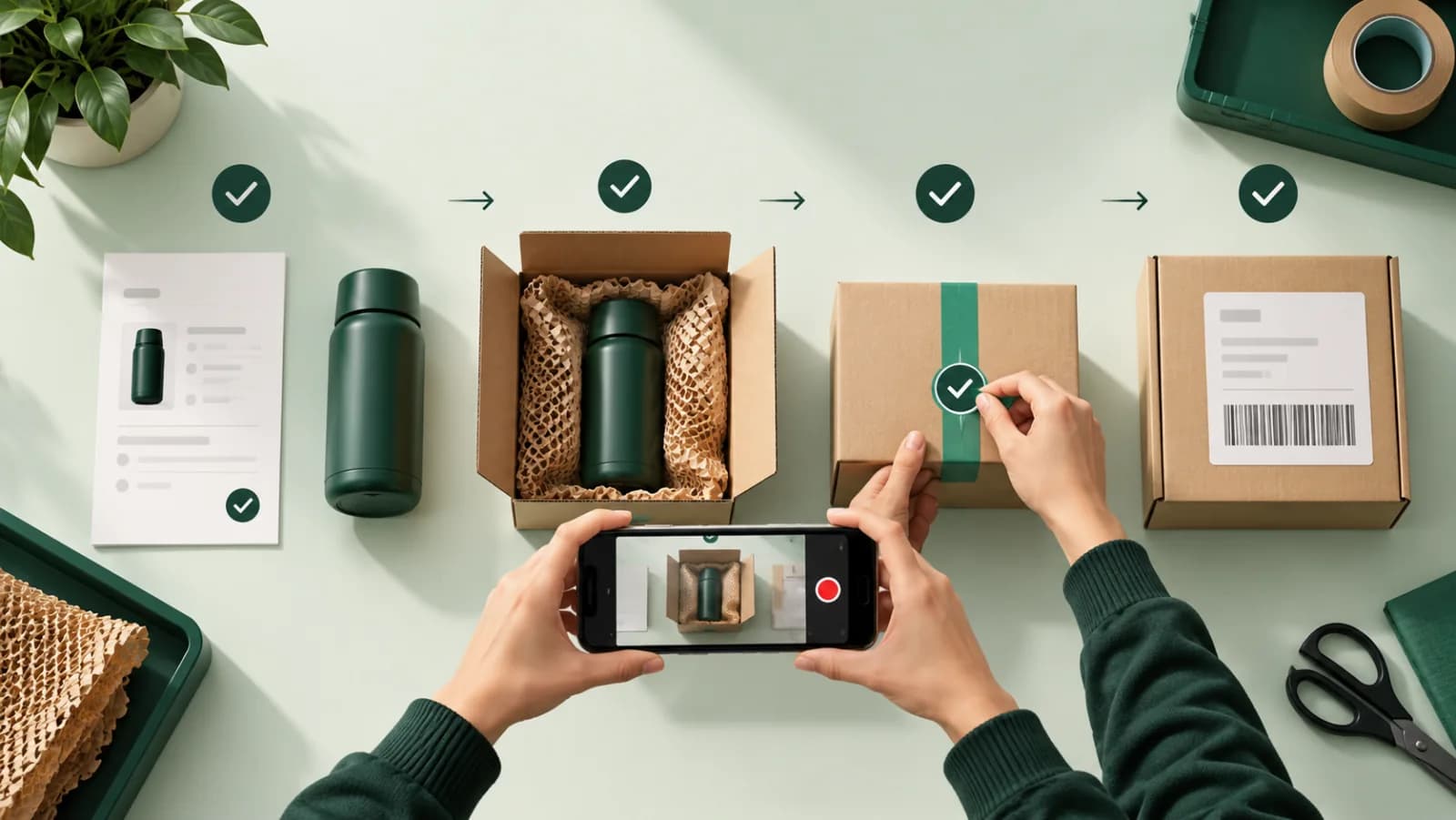
You can create proof of packing with a phone, a clear bench and the same six steps on every order. The routine matters more than the equipment: a process people follow every time beats a better camera used occasionally.
To put this routine in writing for a team, use the packing station SOP template. It turns these six steps into a printed procedure with setup checks, photo rules and exception handling.
Proof of shipment vs proof of delivery vs proof of packing
Proof of shipment shows a parcel was handed to a carrier, proof of delivery shows it arrived, and proof of packing shows what was inside it. Each answers a different dispute: not-received claims turn on delivery, while not-as-described, empty-box and wrong-item claims turn on contents.
Mixing them up is the most common reason a strong case loses. A seller answers an empty-box claim with a tracking page, or a not-received claim with a packing video, and the reviewer sees evidence that does not address the question. The full breakdown, with a dispute-by-dispute table, PayPal's definitions and Visa's conditions 13.1 and 13.3, is in proof of shipment vs proof of delivery vs proof of packing.
What makes a packing video count as evidence
A packing video counts as evidence when a reviewer can tie it to the order, trust that it has not changed and open it without help. Seven practical checks get you there: one continuous take, the order reference in the same frame as the item, condition shown before packing, timing fixed by something other than the file's own date, the seal and label on camera, the original never re-encoded, and a link that opens without an account.
The full checklist, with a pass/fail table and common technical mistakes, is in how to record packing video that actually counts as evidence.
A packing station SOP your team can follow
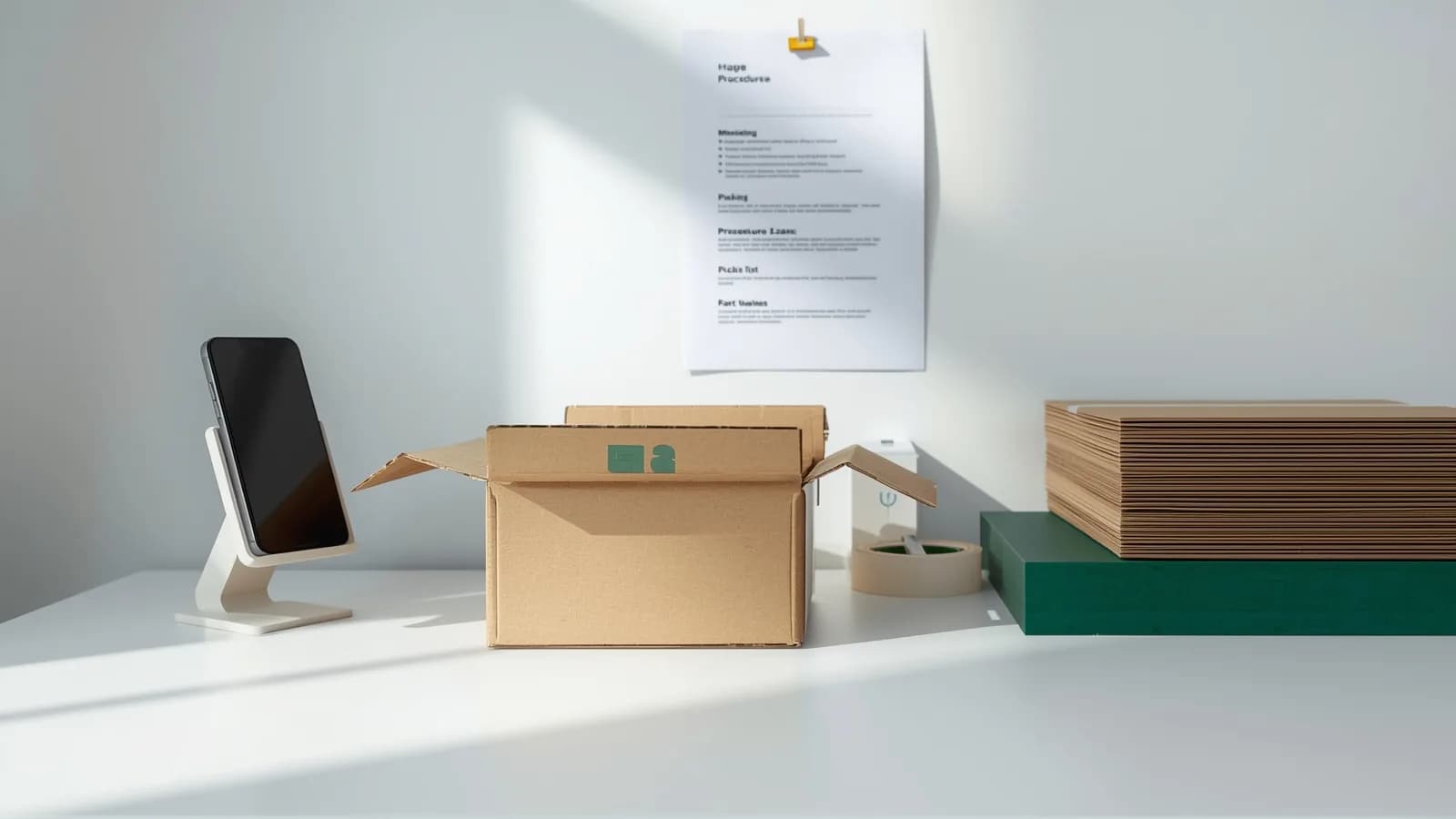
A packing station SOP is a one-page procedure that makes proof of packing routine instead of optional. It fixes the setup, the scan, the recording sequence (item, condition, label, padding, seal), the photo rules and what to do when something goes wrong.
Without one, the process drifts under pressure: the take gets shorter, the label stops appearing in frame, and the orders that matter most are the ones packed in a hurry. Download the free packing station SOP template and adapt it to your bench.
Buyer approval: photo approval before shipping
Buyer approval is proof of packing the buyer has already seen and accepted. Before the parcel ships, the buyer receives the sealed recording of their own order, watches it and taps Approve or Report an issue, and that decision stays on the order.
It is the strongest form of proof of packing for custom, high-value and B2B orders, because a later "this isn't what I ordered" now contradicts the buyer's own approval. Most approval tools approve an order or a design file, not the goods themselves. How to set this up, what to send and how existing tools compare is covered in photo approval before shipping.
Reading labels and serial numbers into the record
Labels carry the identifiers that make proof of packing specific: serial numbers, lot numbers, PO numbers, container seal numbers. Capturing them as data, not just pixels in a video, is what lets you search for "which order got serial ABC123" months later.
There are three ways to capture them: typing, scanning a barcode, or letting AI read the printed label from a photo. Each has its place, and serial numbers are the one field where getting it right decides return-swap cases. The comparison and the receiving and dispatch workflow are in AI label reading for serial numbers, lots and seals.
Proof of packing on Shopify and WooCommerce
On Shopify and WooCommerce, proof of packing works best when orders flow in from the store and the record flows back to the order. Scanning the order barcode then opens the right order, and the proof link sits on the order where your support team already works.
Setup is different on each platform. See packing video proof on Shopify and packing video proof on WooCommerce for platform-specific steps, and the Shopify integration and WooCommerce integration pages for how orders sync.
Proof of packing in card and marketplace disputes
In card and marketplace disputes, proof of packing answers goods-related claims, and it has to arrive in the format the form accepts. Shopify's chargeback instructions accept only PDF, JPEG or PNG, cap each file at 2 MB and the total at 4 MB, and say not to include video files or links to external resources. Stripe's dispute evidence best practices likewise accept only PDF, JPEG or PNG, with a combined limit of 4.5 MB.
So the recording reaches a bank as stills in a PDF, next to the order details and tracking. Packing evidence does not help with fraud (unauthorized payment) disputes, which turn on transaction data instead; which disputes packing video can support explains the split. Platform-by-platform rules, deadlines and file limits are collected in seller dispute evidence by platform.
Proof of packing in carrier damage claims
In a carrier damage claim, proof of packing shows the item was intact and properly packed when the carrier took it, which is the point carriers contest most. Carriers set their own windows and documentation rules. USPS, for example, says on its claims page that damage claims can be filed no later than 60 days after the mailing date, that photos clearly showing the damage help, and that the original packaging should be kept until the claim is settled.
A recording of the padding going in and the box being sealed is your answer when a claim is denied for "insufficient packaging." Carrier-by-carrier requirements are in shipping damage claims by carrier.
Proof of packing against return fraud
Against return fraud, proof of packing is the "before" picture: the serial number, condition and contents of what you shipped, against which a returned item can be compared. In the 2025 NRF and Happy Returns returns survey, retailers estimated that 9% of all returns are fraudulent.
Empty-box claims, swapped units and worn-then-returned items all come down to comparing what left with what came back. Start with the customer says the box was empty and the customer says you sent the wrong item, then the full return fraud evidence playbook.
Proof of packing for warehouses and 3PLs
For warehouses and 3PLs, proof of packing extends beyond parcels to receiving, pallets, lots and loadout, and the "buyer" is often a client brand asking why their stock arrived short. The record is tied to a shipment, pallet or lot reference and to the client it belongs to, so it can be shared with that client and nobody else.
How a warehouse records packing proof covers pallets, shifts and multilingual teams; the 3PL evidence playbook covers receiving, storage, mispicks and contract clauses.
Choosing proof of packing software
Proof of packing software should be judged on the three tests, not on the camera. Many tools record a clip and attach it to an order; far fewer fingerprint the file, publish a page a stranger can verify, let the buyer approve before dispatch or produce a document a bank will accept.
Packing video software compared lays out what each tool records and what it proves, with published prices.
Proof of packing by industry
What proof of packing needs to show changes by industry. Jewelry needs the item and its certificate in one shot; electronics need the serial number and a powered-on screen; trading cards need the card's condition under the sleeve; food needs temperature packs visible before sealing.
Proof of packing by industry collects vertical guides with the shots each one requires.
Free proof of packing templates
Templates make proof of packing repeatable before you have any software in place. A printed SOP, a receiving discrepancy form or a quarantine log gives every record the same fields, which is what a reviewer looks for.
All free templates, including the packing station SOP, are collected in free evidence templates.
Common proof of packing mistakes
The most common proof of packing mistakes are about the record's links, not its picture quality. These are the ones that turn a usable recording into an assertion:
| Mistake | Why it fails | Fix |
|---|---|---|
| Filming the product without the order reference | Fails test 1: nothing ties the item to this order | Scan the order first; keep the slip or label in frame |
| Cutting or trimming the take | A cut is a place a reviewer can imagine a swap | One continuous take; start a second recording rather than editing |
| Stopping before the label goes on | Leaves the gap between bench and carrier open | Record until the tracking number is readable |
| Sending a re-exported copy | The copy's fingerprint no longer matches the original | Share the original through its verification link |
| Sending a video file to a bank | Card dispute forms take PDF, JPEG or PNG | Submit stills in a PDF with order details and tracking |
| Treating tracking as proof of contents | Proof of shipment is silent on what was inside | Pair tracking with proof of packing for goods claims |
| Recording only "risky" orders on gut feel | Disputes rarely come from the orders you expected | Record by rule (value, SKU, buyer) or record everything |
| Relying on warehouse CCTV | Hard to tie a wide shot to one order among hundreds | Record at the bench, bound to the order |
How PallasMark covers proof of packing end to end
PallasMark is a complete order-evidence system built around proof of packing, running on the phones your team already has. It covers every step in this guide, from the scan at the bench to the PDF a reviewer reads.
Capture tied to the order. Record video and photos in the PallasMark app on iPhone or Android, in seven languages, or in the browser. Scan the barcode on the picking slip or shipping label and the app opens that order, so the recording is bound to it before the first frame. Orders arrive on their own from Shopify, WooCommerce, ShipStation, ShipHero and Amazon Seller Central (US and Canada), and manual orders work too. No mounted cameras, no fixed station, no per-station fees.
Sealed and verifiable. Every stored file gets a SHA-256 fingerprint, and every proof has a public verification page that re-hashes the stored file on the spot and shows whether it still matches. A buyer, bank, carrier or marketplace agent opens it with no account. There is no edit button for recordings anywhere in the product. Details are on the tamper-proof video page.
Approved by the buyer. For orders you choose, send the sealed recording to the buyer with one tap before dispatch. They watch it in their browser and approve or report an issue; the record keeps how long they watched. See buyer approval.
Labels and serial numbers as data. Custom fields capture serial, PO, lot or seal numbers, and AI label reading fills them from a photo of the label into an editable form the operator reviews before saving.
One file for the dispute. On request, PallasMark builds an evidence PDF for the order: four stills from each recorded video (up to six videos), order details, photos, fingerprints, buyer approval, return evidence, and the carrier and tracking number read from your store. You download it and upload it to the payment provider, marketplace or carrier. See chargeback evidence.
Returns and warehouses. When a return opens, the buyer can be asked to film what they are sending back (automatic for Shopify and ShipHero returns), so you compare their footage with your proof of packing. Warehouse records cover receiving, packing, loading and dispatch, tied to a shipment, pallet or lot and, for 3PLs, a client brand. See return evidence and warehouse proof.
For a store, the starting point is proof of packing for online stores; the category page packing video proof shows the full flow, and packing QA and returns show it applied. There is a free plan with no card: create an account or compare plans and pricing.
Frequently asked questions
What is proof of packing?
Proof of packing is a record made at the packing bench, before a parcel ships, that shows which items went into which order's box and in what condition. It is bound to the order and sealed so a third party can check it was not edited afterward. It is usually a continuous video, a photo sequence, or both.
Is proof of packing the same as proof of shipment?
No. Proof of shipment is a carrier document showing that a parcel was handed over, with a tracking number, ship date and destination address. It says nothing about what was inside the parcel. Proof of packing covers the contents and condition at the moment the box was sealed, which is the question behind not-as-described, empty-box and wrong-item claims.
Does a packing video count as evidence in a card dispute?
It can support a goods-related dispute, such as not as described or damaged, but usually not as a video file. Shopify and Stripe accept only PDF, JPEG or PNG for dispute evidence, so the recording is normally submitted as stills inside a PDF with the order details and tracking. Visa's merchant dispute guide lists inspection records showing an item's condition before shipment as relevant documentation for not-as-described disputes.
Do I need special cameras or a fixed packing station?
No. A phone on a stand covers the capture. What a phone does not do on its own is bind the recording to an order, fingerprint the file and publish an address someone else can check. That is the part software adds, and it is what turns a clip into proof of packing.
Which orders should get proof of packing?
Start with the orders you would least like to lose: high-value, fragile, frequently disputed SKUs, custom work and first orders from new buyers. Many teams record every order once the routine is in place, because a dispute rarely announces in advance which order it will be about.
Can the buyer see the proof of packing before the parcel ships?
Yes, if you choose to send it. With buyer approval, the buyer opens a link, watches the sealed recording of their own order and taps Approve or Report an issue before dispatch. That turns a later not-as-described claim into a question about something the buyer already approved.
How do I create proof of packing with PallasMark?
Scan the order barcode in the PallasMark app on iPhone or Android, record the pack in one take, and upload. The file is fingerprinted with SHA-256, tied to the order and given a public verification page that anyone can open without an account. When a dispute arrives, you can generate an evidence PDF for the order and upload it yourself to the payment provider, marketplace or carrier.
- proof of packing
- packing proof
- packing evidence
- packing video
- dispute evidence
- order evidence