Part of the Proof of packing guide
Proof of shipment vs proof of delivery vs proof of packing, explained


On this page
Sellers use "proof" loosely. A tracking number gets called proof of shipment, proof of delivery and proof that the right item went out, often in the same dispute reply. Reviewers do not use the word loosely. Each of these records answers one specific question, and an answer to the wrong question is treated as no answer at all.
This page defines the three terms, shows which dispute each one settles, and sets out what PayPal, Visa and Shopify actually say about them. Rules quoted here were checked in October 2026.
Proof of shipment, proof of delivery and proof of packing, defined
The three terms describe three moments in a parcel's life, recorded by two different parties. The carrier records the handover and the arrival. Only the seller can record the packing.
What is proof of shipment?
Proof of shipment is a carrier-issued record that a parcel was handed over for transport, showing when it was sent and where it was addressed.
PayPal's help article What is proof of shipment? describes it as online or physical documentation from a shipping company that includes the ship date and the recipient's address, with at least the city and state or an equivalent. Its Seller Protection program (last updated January 26, 2026) adds an online, verifiable tracking number and requires that the address match the shipping address on the Transaction Details page.
Typical forms: a carrier acceptance scan in tracking, a drop-off receipt, a carrier manifest.
What is proof of delivery?
Proof of delivery (POD) is a carrier-issued record that a parcel arrived at its destination, showing when, where and sometimes who received it.
Shopify's guide to proof of delivery defines POD as a physical or electronic record that confirms a shipment was successfully delivered to the correct recipient, in paper or digital form, typically carrying recipient details, tracking numbers, barcodes and signatures. PayPal's Seller Protection definition is narrower: carrier documentation with a verifiable tracking number, the date of delivery and a "delivered" status, and an address matching the transaction.
Visa's dispute management guide for merchants (October 2026 edition) describes a valid POD for physical goods as the full delivery address matching the invoice plus the courier's delivery status details, and says it can also include a recipient signature or a delivery photo showing where the item was left.
What is proof of packing?
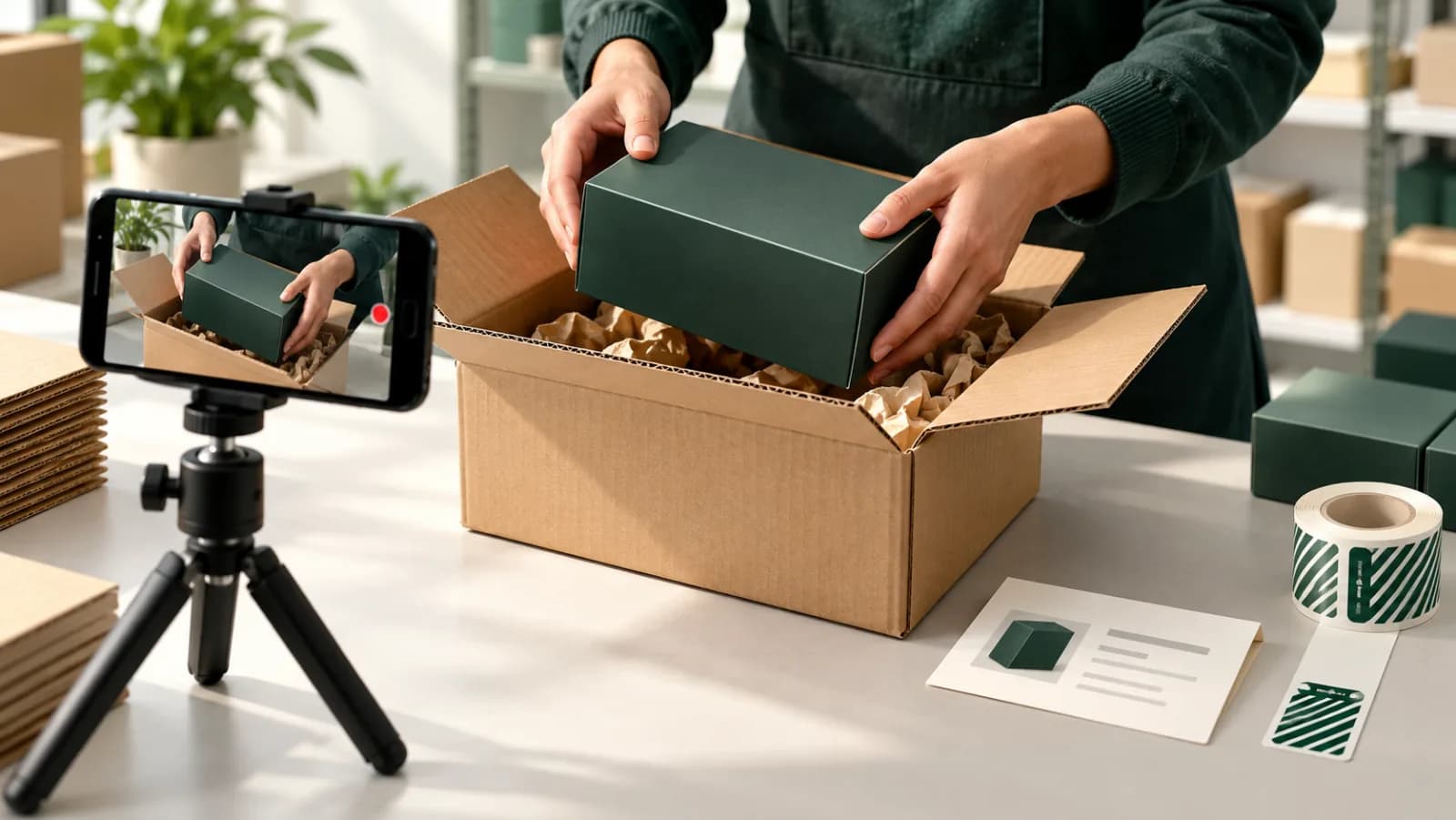
Proof of packing is a seller-made record, created before the parcel is sealed, that shows which items went into which order's box and in what condition, bound to that order and sealed so a third party can verify it was not edited.
It is usually a continuous video, a photo sequence or both: the order barcode, each item and its condition, the padding, the seal and the shipping label with the tracking number readable. The full definition and the three tests it has to pass are in what is proof of packing.
How the three records differ
The three records differ in who makes them, which moment they cover and what they can prove. The short version: carrier records cover movement, the seller's record covers contents.
| Proof of shipment | Proof of delivery | Proof of packing | |
|---|---|---|---|
| Moment covered | Handover to the carrier | Arrival at the address | Sealing the box |
| Made by | Carrier | Carrier | Seller |
| Typical contents | Tracking number, ship date, destination address | Tracking number, delivered status, delivery date, address; sometimes signature or photo | Order reference, items, condition, identifiers, seal, shipping label |
| Proves | A parcel was sent, when and where to | A parcel arrived, when and where | Which items were packed for this order, and their condition |
| Cannot prove | What was inside; that it arrived | What was inside; its condition inside the box | What happened in transit or after delivery |
| Who can produce it later | Anyone with the tracking number | Anyone with the tracking number | Only the seller, and only if it was recorded at the time |
That last row is the practical point. Carrier records can be retrieved after a complaint arrives. Proof of packing cannot be created after the fact: if the order was not recorded at the bench, it does not exist.
Which dispute each one answers
Each record answers a different claim, and the claim type decides which record a reviewer will weigh. Check what the buyer is actually saying before choosing what to send.
| Buyer's claim | The question being decided | Proof of shipment | Proof of delivery | Proof of packing |
|---|---|---|---|---|
| Item not received (INR) | Did the parcel arrive? | Supports (it was sent) | Primary evidence | Supports (it was packed and sealed) |
| Significantly not as described (SNAD) | Did the goods match the listing? | Not relevant | Not relevant | Primary evidence, with the listing |
| Empty box | Was the item in the box? | Not relevant | Shows the box arrived | Primary evidence |
| Wrong item or wrong variant | Which item went in? | Not relevant | Not relevant | Primary evidence |
| Arrived damaged | Was it intact and well packed at handover? | Shows when the carrier took it | Shows when it arrived | Primary evidence for condition and packaging |
| Unauthorized payment (fraud) | Did the cardholder make this purchase? | Supports in some programs | Supports | Not relevant |
Empty-box and damage claims show why this matters. A seller who answers "the box was empty" with a tracking page has proved the box arrived, which the buyer already agrees with. The argument is about contents, and only one column speaks to that. Our guides to the empty box claim and the arrived damaged claim walk through each response.
PayPal proof of shipment requirements
PayPal's Seller Protection accepts proof of shipment or proof of delivery for most eligible claims, requires proof of delivery for Item Not Received claims, and does not cover Significantly Not as Described claims at all. Here is how the two definitions compare in the US program, checked October 2026:
| Element | PayPal proof of shipment | PayPal proof of delivery |
|---|---|---|
| Source | Online or physical documentation from a shipping company | Online or physical documentation from a shipping company |
| Tracking | Online and verifiable tracking number | Online and verifiable tracking number |
| Date | Date of shipment | Date of delivery and "delivered" status |
| Address | Matches the shipping address on the Transaction Details page; at least city/state, city/country or postal code | Same |
| Required for | Basic eligibility (shipment or delivery) | Item Not Received claims |
Two details catch sellers out:
- Signature confirmation. PayPal's article on how to prove you sent an item says transactions over $750 processed before January 26, 2026 required signature confirmation; for later transactions it is recommended but not mandatory.
- SNAD is excluded. The Seller Protection policy lists claims that the item sent is not what was ordered (Significantly Not as Described) among the exclusions. Perfect proof of shipment does not help there. The case is decided on what each side can show about the item itself, which is where proof of packing comes in.
Visa condition 13.1 vs 13.3
Visa splits the two most common goods disputes into condition 13.1, Merchandise/Services Not Received, and condition 13.3, Not as Described or Defective Merchandise/Services. They need different evidence.
| Condition 13.1: Not received | Condition 13.3: Not as described or defective | |
|---|---|---|
| Cardholder says | The item never arrived | The item arrived but differs from the description, is defective or damaged |
| What Visa's guide asks you to show | Delivery: proof of delivery with the full address matching the invoice and the courier's delivery status | That the goods materially matched the description, images and terms shown before purchase, or that the issue was handled under your disclosed policy |
| Examples it gives | Recipient signature, delivery photo, receipt confirmation sent to the cardholder | Checkout description, matching images or specs, quality-assurance or inspection records of condition before shipment |
| Role of proof of packing | Supporting: shows the parcel was packed and sealed | Central: the inspection record of what was shipped |
Visa's guide also tells merchants to inspect merchandise before shipping and document the inspection with checklists or photos, and notes that internal inspection records support, rather than replace, the customer-facing description. In practice that means proof of packing is strongest when it is filed next to the listing as the buyer saw it.
Card disputes run on documents. Shopify's chargeback instructions accept only PDF, JPEG or PNG and say not to include video files or links to external resources, so a packing recording reaches the bank as stills in a PDF. Platform-by-platform rules are in seller dispute evidence by platform.
Shopify proof of delivery, in context
Shopify uses "proof of delivery" in the carrier sense: a record that confirms a shipment reached the right recipient. Its guide lists recipient details, order details, tracking numbers, barcodes and signatures as typical POD contents, which is accurate for what a POD proves and silent on contents, because no carrier opens the box.
The order details a POD carries are the items that were ordered, copied from the order. That can look like proof of contents on a screen, but it is the order restated, not a record of what was packed. For a Shopify store, the contents record has to come from the bench; packing video proof on Shopify shows how to make one per order.
Examples: the same parcel, three records
Three short cases show which record does the work.
Item not received. A buyer says the parcel never came. Tracking shows a delivered scan at the correct address with a doorstep photo. That is proof of delivery, and it answers the claim. The packing video is a useful supporting page, nothing more.
Wrong color. A buyer says they received the navy jacket instead of black. Tracking shows a normal delivery, which nobody disputes. The question is which jacket went in. A packing recording that shows the order barcode, the black jacket and its color label, and the box sealing is the record that answers it.
Empty box. A buyer says the box arrived empty, seal intact. Proof of shipment and delivery confirm a box traveled and arrived. Only a recording of the item going into that box before it was sealed speaks to the claim, and if it shows the item packed and the seal applied, the remaining question is about what happened after handover, not at your bench.
How to create each record
Proof of shipment and proof of delivery come from the carrier, so creating them mostly means choosing a service that produces them. Proof of packing has to be created by you, at the bench, on every order you may need to defend.
For custom or high-value orders, one more step closes the loop: send the sealed recording to the buyer and get their approval before the parcel ships. Photo approval before shipping explains how. For serial-numbered goods, capture the serial as data as well as on video; AI label reading for serial numbers covers that.
When a goods claim arrives, combine the three in one short note:
How PallasMark handles proof of packing
PallasMark creates the one record carriers cannot: proof of packing, tied to the order and verifiable by anyone. It runs on the phones your team already has, so there is nothing to install at the bench.
Scan the order barcode in the PallasMark app and the order opens, so the recording is bound to it before the first frame. Every stored file gets a SHA-256 fingerprint, and each proof has a public verification page that re-hashes the stored file and shows whether it still matches, with no account needed. Photos are stamped with your company name, the order number and the upload time inside the image file.
When a dispute arrives, PallasMark builds an evidence PDF for the order on request: four stills from each recorded video, order details, photos, fingerprints, any buyer approval, and the carrier and tracking number read from your store. That puts proof of packing and the carrier's records in one document, in the format a card dispute form accepts. You download it and upload it to the payment provider, marketplace or carrier yourself. See packing video proof for the full flow and tamper-proof video for how the seal works.
For how proof of packing fits with every other record in a dispute, start at the hub: what is proof of packing.
Frequently asked questions
What is the difference between proof of shipment and proof of delivery?
Proof of shipment is a carrier record that a parcel was handed over for transport, with a tracking number, a ship date and the destination address. Proof of delivery is a carrier record that it arrived, with a delivered status, a delivery date and the address, sometimes with a signature or a photo. Neither describes what was inside the parcel.
What counts as proof of shipment for PayPal?
PayPal's US Seller Protection program defines proof of shipment as online or physical documentation from a shipping company that includes an online, verifiable tracking number, the date of shipment, and a recipient address that matches the shipping address on the Transaction Details page, showing at least the city and state or the postal code. Check the current version of the policy for your country before relying on it.
Does proof of shipment prove what was in the box?
No. Proof of shipment and proof of delivery are produced by the carrier and describe a parcel's movement, not its contents. To show what was inside, you need a record made before the box was sealed, such as a continuous packing video or photo sequence bound to the order. That record is what this article calls proof of packing.
Which proof do I need for an item not received claim?
Proof of delivery. PayPal requires proof of delivery for Item Not Received claims to qualify for Seller Protection, and Visa's merchant dispute guide asks for proof of delivery with the full delivery address and the courier's delivery status for condition 13.1. Proof of packing helps show the parcel was packed and sealed, but delivery is the question being asked.
Which proof do I need for a not as described claim?
Proof of packing, alongside the listing as it was shown at checkout. PayPal Seller Protection excludes Significantly Not as Described claims, so there is no policy shortcut. Visa's guide lists inspection records showing an item's condition before shipment as relevant documentation for condition 13.3, and says those records support, but do not replace, the description the buyer saw.
Is a delivery photo proof of what was delivered?
A delivery photo shows where a parcel was left and that it looked intact from the outside. It does not show what was inside. Visa's guide mentions a delivery photo as something proof of delivery can include, which makes it useful for not-received claims but not for contents claims.
How do I create proof of packing?
Scan the order barcode before you start recording, show every item and its condition, pack and seal in one continuous take, and show the shipping label with the tracking number readable. Then store the original file so it is fingerprinted and can be checked by someone outside your business. PallasMark does this on any phone and builds an evidence PDF for the order on request.
- proof of shipment
- proof of delivery
- proof of packing
- paypal seller protection
- chargebacks
- dispute evidence