Part of the Industry guides guide
Artwork condition report before shipping: free template with photo steps

On this page
Printable resource
Artwork Condition Report Template
A two-page condition report for shipping artwork: identification, overall and detail photo checklist, a clock-face damage map for front and back, crating steps and a sign-off block for both parties.
A damaged painting arrives, and three parties start arguing about one question: was that crack there before? Without a report made before packing, nobody can answer it, and the insurer, the carrier and the gallery each have a reason to assume it was. The template below is the answer you prepare in advance. It is built on museum condition-reporting practice and on what fine art shippers and online art platforms ask for today.
When to use an artwork condition report
Use one every time a work leaves your care or changes hands: a sale to a collector, a consignment to a gallery or its return unsold, a loan, an art fair, or a sale through an online platform. The report is the baseline; without it, any damage found on arrival is one party's word against another's.
Museums have done this for decades. Te Papa's condition reporting resource guide lists resolving disputes over damage during loans or transport, and supporting insurance claims, among the main reasons to report, and warns that insurance claims can be difficult without recent condition reports. Fine Art Shippers' guide to documenting condition before shipping frames the report as the reference for owners, insurance brokers and logistics providers.
The commercial channels are stricter than many artists expect:
| Who reviews the shipment | What they ask for or limit | Source, checked October 2026 |
|---|---|---|
| Saatchi Art | Photos of the packed artwork with the label attached, dimensions measured with a ruler, packaging materials; poor packaging makes the shipment non-insurable and the artist responsible | Saatchi Art shipping insurance |
| FedEx | Recommends artwork ship with a declared value and limit of liability of no more than $1,000; offers Premium Art Boxes for work over $500 | FedEx, how to ship artwork |
| UPS | Does not accept packages with an actual value over $50,000 | UPS Tariff 2026 |
| Museums and lenders | The travelling condition report is treated as a legal document; borrowers contact the lender within 24 hours of any change | Te Papa resource guide |
The pattern is the same everywhere: the shipper carries the burden of showing the work was sound and properly packed when it left.
The artwork condition report template
Copy the sections below or download the two-page PDF. Fill in one report per work.
Section 1: Identification and examination
| Field | What to write |
|---|---|
| Artist, title, date | As on the invoice or certificate |
| Medium and support | For example oil on linen, archival pigment print, bronze |
| Dimensions | In millimetres: unframed and framed (height × width × depth) |
| Inventory or edition number | Your catalogue number; edition as 3/25 |
| Framing, glazing, backing | Frame type, glass or acrylic, backing board, hanging hardware |
| Labels, stamps, signatures | Front and back: gallery labels, stamps, signature location |
| Examined by, date, place | Name and role of each person present |
| Overall condition | One word from a fixed scale: Excellent, Good, Fair, Poor, Very poor |
Section 2: Photographs
Section 3: Clock-face damage map
Record each defect once, with its side, position and size, and the photo that shows it.
| # | Side (front / verso / frame) | Clock position | Distance from nearest edges (mm) | Defect and size | Photo ref |
|---|---|---|---|---|---|
| 1 | Front | 2 o'clock | 40 from top, 25 from right | Hairline crack, 18 mm | P-07 |
| 2 | Frame | 7 o'clock corner | At corner | Gilt loss, 6 × 3 mm | P-11 |
| 3 |
Section 4: Packing and crating
Section 5: Sign-off
How to fill in the condition report
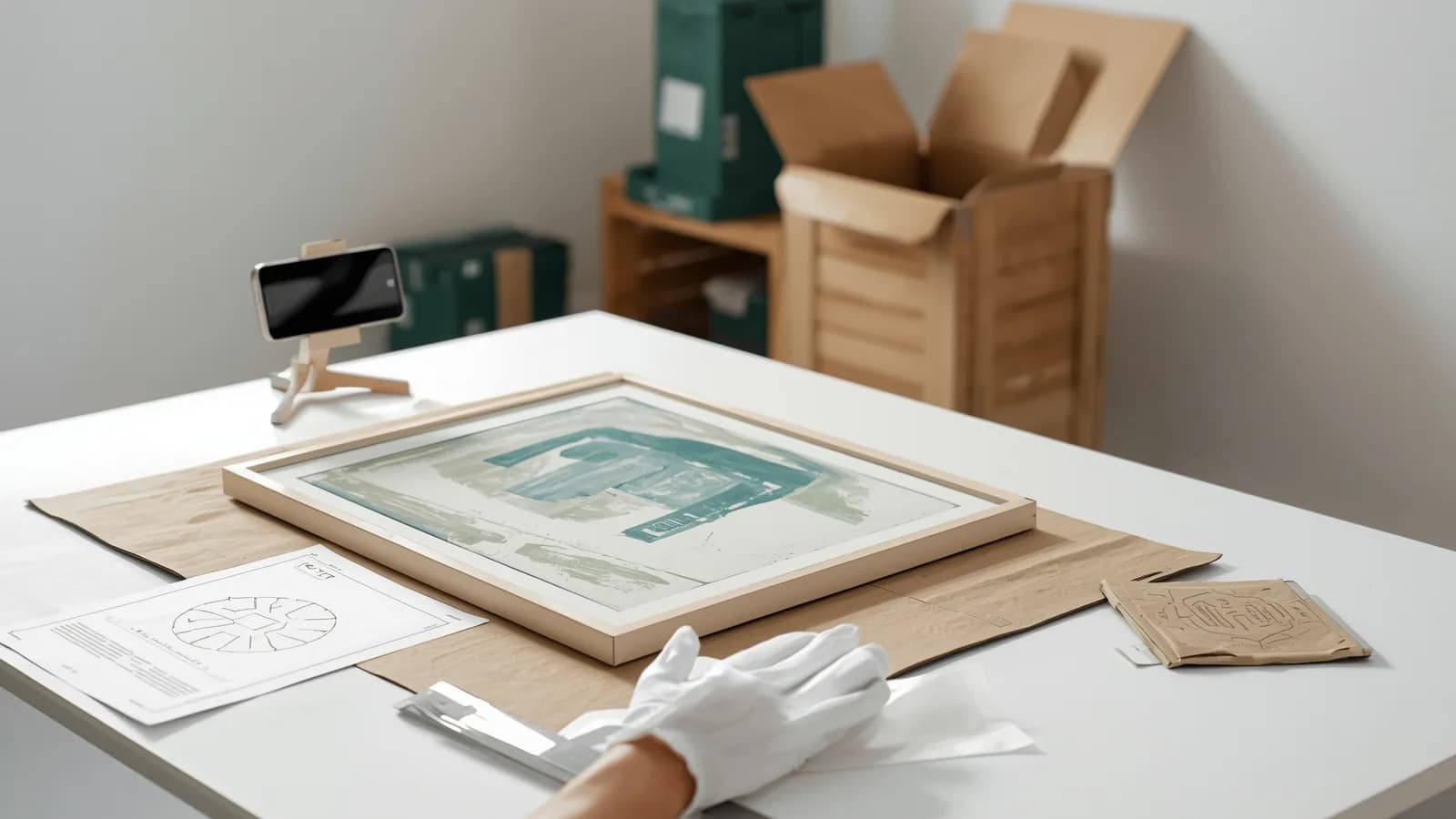
Examine the work before anything touches it, under even light, with clean gloves and a stable support, and write what you see in neutral terms. A good report reads the same to a conservator, an adjuster and a collector.
- Use a fixed rating scale. Museums & Galleries of NSW's condition report fact sheet recommends a limited vocabulary with definitions, such as Excellent, Good, Fair, Poor and Very poor, so two people rate the same work the same way.
- Measure in millimetres, framed and unframed. The same fact sheet says framed works should be measured in both states, taken at the extremes.
- Locate with a clock face. Picture a clock laid over the work: 12 at the top centre, 3 at the middle of the right edge, 6 at the bottom centre, 9 at the left. For the verso, write "verso" every time, because 3 o'clock on the back sits behind 9 o'clock on the front. Add the distance from the nearest edges; Te Papa's guide gives "250 mm from right and 165 mm from bottom" as the level of precision small works need.
- Use proper left and proper right for objects. For sculpture and 3D work, describe sides as the object would see them, as the NSW sheet explains.
- Say when you are unsure. "Possibly" or "may be" keeps a report honest; a cause you guessed and wrote as fact can be used against you later.
- Record changes only on arrival. Te Papa's guide tells the receiving side to note change since the last examination, not to write a new report.
Turning the report into evidence
A condition report becomes evidence when its photos and video are tied to the same work, the same shipment and the same moment, and when nobody can quietly swap a file afterwards. Paper alone does not do that; a dated record that cannot be edited does.
Three habits close the gaps:
- One reference on everything. Put the inventory number (or order number) on the report, in the first frame of the video and in the photo names.
- Film the crating in one take. From the documented work, into its protection, into the box or crate, closed, labelled. Parcel Pro's high-value shipping guide advises recording the packing process to help prove the contents in a claim, and triple-ply cardboard or wooden crates for high-value art. Saatchi Art asks artists to photograph each step.
- Ask the recipient to document before unwrapping. Photos of the crate as delivered and of the work in its packing, before anything is removed, mirror your outgoing record and show where any change happened.
If the work arrives damaged, the comparison is then simple: your report says the 2 o'clock corner was sound at 10:42 on the day it was crated; the arrival photo shows a crack there. That is a transit question, and the carrier or insurer process for packaging-related claim denials is where the crating video earns its keep. For works shipped with jewelry-level values, the same discipline appears in the jewelry shipping security SOP, and sellers of graded collectibles use it in trading card shipping protection.
How PallasMark digitizes the condition report
PallasMark keeps the whole report, its photos and the crating video on one record, sealed so it can be checked by anyone you send it to. It runs on the phone or browser you already use, so a studio, a gallery back room or an art-fair stand needs no extra equipment.
- Tied to the work or the sale. Sell through Shopify or WooCommerce and the order is already there; sell privately and create a manual order or a standalone record with no store connection. Custom fields on warehouse records hold the inventory number, edition and dimensions.
- Sealed at capture. Every file gets a SHA-256 fingerprint and a public verification page, so a frame changed after the work left would show. Photos are stamped with your company name, the order number and the upload time inside the image. How the check works is explained on how verification works.
- Approved by the collector before it ships. With buyer approval, the collector opens a link with no account, watches the condition video and the crating, and approves or reports an issue before the crate is collected. The record keeps their decision and how long they watched, and you can require them to watch a share of the video first. The same idea is covered in depth in photo approval before shipping.
- Shared with the gallery, shipper or insurer. Share one record through a link with an expiry, an optional PIN and download settings, revocable at any time.
- One file for a claim. The evidence dossier PDF gathers stills from the crating video, the photos, the fingerprints and the buyer's approval for the order, ready for you to attach to an insurer's or carrier's claim. It supports both authenticity and warranty questions and carrier and insurance claims.
The free plan needs no card; see pricing. This template is part of packing proof by industry, and you will find the rest of our printable forms in free evidence templates.
Frequently asked questions
What should an artwork condition report include before shipping?
Identification (artist, title, date, medium, dimensions framed and unframed, inventory number), who examined it and when, the framing, glazing and backing, every label or stamp, an overall condition rating, and each existing defect with its location and size. Overall photos of the front and back plus close-ups of corners, edges, frame and each defect complete it. Both parties sign and date it.
How do I describe where the damage is on a painting?
Use a clock-face or grid reference and measurements. Picture a clock over the work, with 12 at the top centre and 3 at the right edge, and write the position plus the distance in millimetres from the nearest edges, for example 2 o'clock, 40 mm from top, 25 mm from right. Te Papa's condition reporting guide recommends millimetre references from the nearest edges, or a photo with marked overlays, for exact locations.
Who should sign an artwork condition report?
The person who examined the work signs and dates the outgoing report, and the recipient signs on arrival, noting only what has changed. For loans, Te Papa's guide says lenders should countersign the report and that the travelling report should be treated as a legal document. For a sale, ask the collector or gallery to sign the arrival section, or to approve the record from a link.
Do carriers insure artwork?
Only in limited amounts. FedEx recommends shipping artwork with a declared value and limit of liability of no more than $1,000, and declared value is not insurance. The 2026 UPS Tariff does not accept packages with an actual value above $50,000. Valuable work usually ships with a fine art shipper or under specialist fine art insurance, and those insurers will ask for a condition report.
Is a condition report the same as an appraisal?
No. A condition report records the work's physical state at a moment in time, defects included. An appraisal sets its value. You will often need both for a claim: the condition report shows what changed in transit, and the appraisal or invoice shows what that change is worth.
Does Saatchi Art require photos before an artwork ships?
Yes. Saatchi Art's shipping insurance article asks artists for photos of the fully packaged artwork with the shipping label attached, the package dimensions measured with a ruler, and the packaging materials used. It says artwork damaged because of poor packaging is treated as non-insurable and the artist is held responsible, and it strongly recommends photographing each step of the packing.
Can the collector check the condition record without an account?
Yes, if it is recorded in PallasMark. Each recording and photo has a public verification page that re-checks the file's SHA-256 fingerprint on the spot, so the collector, gallery or insurer can confirm nothing was changed after the work was crated. No account or login is needed.
- artwork shipping
- condition report
- fine art
- art galleries
- shipping documentation
- templates