Part of the Industry guides guide
Perishable shipping claims: what to photograph before it arrives melted

On this page
Every food brand that ships cold gets the same message sooner or later: the box arrived warm, the ice cream is soup, the steaks are soft. Some of those claims are a carrier delay, some are a box that sat on a porch all afternoon, and some are a packer who used two gel packs instead of four. From the customer's photo alone you cannot tell which. From your own pack-out record, usually you can.
What a melted-on-arrival claim actually turns on
A melted-on-arrival claim turns on three questions: was the parcel packed to survive the planned transit, did it arrive inside that window, and was it reported fast enough for the evidence to mean anything. The customer can answer the last two with tracking and a timestamped photo. Only you can answer the first.
The customer's evidence has a hard limit. Goldbelly's help article on thawed orders asks for photos of the package and contents within 14 days and says it plainly: a photo cannot show temperature. A picture of soft packaging and wet gel packs looks the same whether the box was packed short, delayed two days or left in the sun.
The carrier route is mostly closed as well. The 2026 UPS Tariff/Terms and Conditions of Service (section 3.15, effective April 17, 2026) says UPS provides no protective service for perishable commodities and that shippers shall not file claims for damage arising from exposure to heat or cold or the perishable nature of the item, even when the shipment is delayed in transit. FedEx's perishables packing guide states that proper packaging is the sole responsibility of the shipper.
So the reviewer is almost always you: your support team applying your policy, your shipping-protection provider applying theirs, or, for wholesale, a marketplace such as Faire, which gives retailers a "spoiled or melted" report type for food and drink. Each of them asks the same thing: show me how this box was packed.
Carrier, food-safety and marketplace rules for perishable claims
The rules below set what your pack-out should show and what a claim can and cannot recover. All were checked on the source pages in October 2026.
| Source | Rule | What it means for your evidence |
|---|---|---|
| UPS Tariff 2026, §3.15 | No protective service for perishables; no claims for damage from heat, cold or the perishable nature of the item, delivered on time or delayed | Spoilage is decided by your policy or your protection provider, not the carrier |
| UPS Tariff 2026, claims section | Domestic claims must be noticed within 60 days of delivery; original packaging must be available for inspection if UPS asks | A crushed or broken carton is a different claim; keep the packaging and photograph it |
| FedEx perishables guide | Foam container with walls of at least 1-1/2 inches; gel packs hold 34 to 50 °F; dry ice for frozen items and it is regulated as dangerous goods; 2-mil watertight bags; at least three strips of 2-inch tape, H method; label on top; mark "perishable" | These are the frames your recording should contain |
| FedEx perishables guide, service options | Overnight services recommended; otherwise pack to protect the product at least 24 hours beyond the delivery commitment; ship Monday to Wednesday; consider Hold at Location or Signature Required from May to September | Ship day and service belong on the order record |
| USDA FSIS guidance via Clemson Extension | Mailed food should arrive frozen or partly frozen with ice crystals, or below 40 °F by food thermometer; mark the package "Perishable – Keep Refrigerated"; ship overnight | Ask customers for a thermometer reading; it is the one number a photo cannot give |
| Faire retailer issue reports | Retailers report "spoiled or melted" food and drink within 14 days, with a photo and a description of at least 15 characters | Wholesale food brands face the same claim, with a deduction attached |
Published reporting windows from DTC food brands
Brands that ship cold write their windows short, and they almost all ask for photos. These are their published policies as of October 2026.
| Brand | Window | What the customer must send |
|---|---|---|
| Hatch-green-chile.com (frozen chile that arrives warm) | 4 hours after the carrier's delivery scan | Photos of the box and the affected items |
| Primal Pastures (meat) | 24 hours after delivery | Photos of the box, the insulation, the product and the shipping label |
| Big Texan Steaks | 24 hours for warm or thawed arrivals; 7 days for quality issues found after thawing | Order number and photos of the box, the products and the temperature if they have a thermometer |
| Larry's Catch (seafood) | 48 hours for thawing and condition on arrival | Photos "whenever possible" |
| Goldbelly (marketplace) | 14 days after delivery | Photos of the package and its contents |
Notice what every one of these asks for: the customer's side. None of them, as published, says what the brand itself keeps from the moment of packing. ShipAid's July 2026 piece on perishable claims makes the same point from the claims side: temperature excursions need a photo, and a frozen entrée brand "might need a 48-hour reporting window" while a shelf-stable snack can allow two weeks. The other half of the evidence is yours to create.
How to record a perishable pack-out, step by step
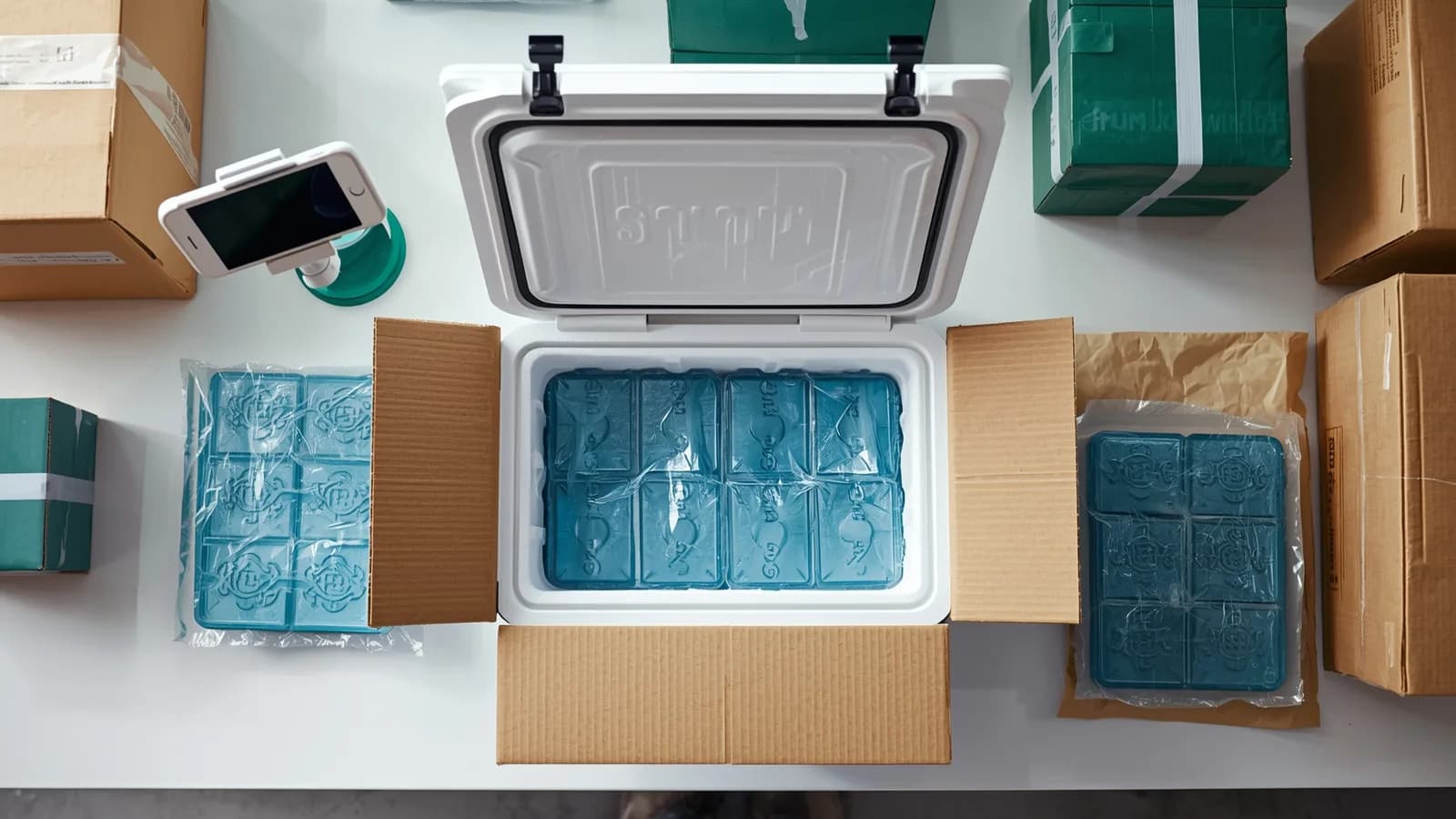
Record one continuous take per order, from the scan to the labelled carton, so nobody has to ask what happened between two photos. The steps follow the FedEx packing sequence, so the recording doubles as proof that you packed to the carrier's own guidance.
A thermometer, a temperature indicator or a data logger in frame makes the record stronger still. You are not trying to prove arrival temperature from the bench; you are proving the starting point.
Set a reporting window your evidence can support
A reporting window should be shorter than the product's safe life after delivery, because a report that arrives after the food would have spoiled anyway cannot tell you anything about transit. Use the published windows above as anchors and set yours by product type:
| Product type | Suggested starting window | Ask the customer for |
|---|---|---|
| Frozen meat, seafood, ice cream | Same day to 48 hours | Box with label, open box with insulation and remaining coolant, product, thermometer reading, time opened |
| Refrigerated and fresh food | 24 hours | Same, plus the best-by date on the pack |
| Chocolate and heat-sensitive confectionery | 24 to 72 hours | Box with label, product, where the box was left |
| Shelf-stable food | Up to 14 days | Product, packaging, label |
Put the window, the photo list and your remedies (replacement, refund or credit) on your shipping policy page and in the delivery email. Creators shipping food as campaign rewards face the same question at scale; see damaged crowdfunding rewards. A customer who knows the list on day one sends complete evidence; one who learns it on day three sends whatever is left.
Read the claim against your pack-out
Once you have both sides, the cause is usually visible, and so is the fair answer.
| Customer's photos and tracking show | Your pack-out shows | Most likely cause | Fair response |
|---|---|---|---|
| Coolant spent, delivery a day or more late | Packed to your rule, shipped early in the week | Transit delay | Replace or refund under your policy; review that lane and service |
| Delivered on time, opened the next evening | Packed to your rule | Porch or mailroom time | Apply your window; goodwill credit is your call |
| Fewer gel packs or no liner | The same gap on video | Packing miss | Refund, then fix the station and retrain |
| Crushed cooler or torn carton | Intact at seal | Handling damage | Spoilage is excluded, but physical damage may be a separate carrier question; keep the packaging |
| A different product, size or date | The order's own items | Mismatch | Ask for a label photo and compare against the order |
For crushed and broken cartons, the general damage process in what to do when a customer says the item arrived damaged applies, and why shipping insurance claims get denied for packaging explains why the pack-out frames matter there too.
What the seller's side actually looks like
Capture on the phone that is already in the room, and a sealed record the other side can open and check without an account.
 You

Video Verification
Verify that a video proof has not been tampered with.
- SHA-256 Hash
- 9f2a4c81…c41d
- Uploaded
- 21 Aug 2026, 14:32
- Burned into video
- Yes
The green verified result appears only after the stored file is re-hashed and compared with this recorded fingerprint.
Copy-ready templates for perishable claims
Keep the language factual. You are describing the packing you can prove, not arguing with the customer about what they found.
How PallasMark handles perishable pack-outs
PallasMark turns the pack-out into a sealed record attached to the order, on the phone already at the packing bench. The packer scans the slip or label, the order opens, and the recording is bound to that order before the first frame. Photos are stamped with your company name, the order number and the upload time inside the image file. Orders arrive on their own from Shopify, WooCommerce, ShipStation, ShipHero or Amazon, so nobody types order numbers into a spreadsheet at 6 a.m.
Every file gets a SHA-256 fingerprint, so changing a single frame shows. The tamper-proof recording has a public verification page that re-checks the file on the spot; a customer, a protection provider or a marketplace agent opens it with no account. That is the link in the reply template above, and the reason it ends arguments instead of starting them.
When the claim needs a document rather than a link, the evidence dossier puts four stills from each recording, the order details, the photos, the fingerprints and the carrier and tracking number read from your store into one PDF. You download it and attach it to the protection claim, the marketplace report or your own approval file; how the same file serves carrier and insurance claims is the same story with a different reviewer.
If you process the claim as a return in Shopify or ShipHero, PallasMark sends the customer a link to film or photograph what they received, and you set how long it stays open (1 to 168 hours) to match your window. Their footage lands on the same order as your pack-out, which is how return evidence keeps both sides on one record.
For large gifting or wholesale food orders, buyer approval lets the buyer watch the sealed pack-out and approve it before the shipment goes, with their decision and watch time kept on the order. A later "it arrived warm" then starts from a pack-out they already accepted. The free plan needs no card; see pricing for plans.
This guide is part of packing proof by industry. Wholesale food brands should also read Faire damaged item reports, and meal-kit or subscription senders the subscription box QC checklist.
Frequently asked questions
Can I file a carrier claim when frozen food arrives thawed?
Usually not for the thawing itself. The 2026 UPS Tariff says shippers shall not file claims for damage to perishable commodities arising from exposure to heat or cold or the perishable nature of the item, even when the shipment is delayed. Physical damage such as a crushed carton is a separate question, so check the carrier's terms for that part and keep the packaging.
What photos should a customer send for a melted or thawed order?
Ask for the outer box with the shipping label, the open box showing the insulation and whatever coolant is left, the product itself, and a thermometer reading if they have one. Food-safety guidance says frozen food should arrive with ice crystals or below 40 °F, so a reading answers the safety question that a photo cannot. Ask for the time they opened the box as well.
How long should my reporting window be for perishables?
Match it to shelf life. Published policies we checked in October 2026 ranged from 4 hours after the delivery scan for frozen chile, through 24 hours for meat and 48 hours for seafood, to 14 days on a gourmet marketplace. A short window keeps the evidence fresh; a window longer than the product lasts tells you nothing about transit.
Does a pack-out video prove the food was still frozen on arrival?
No. It proves what you controlled: the product's state, the insulation, the coolant count and placement, the seal and the ship day for that order. Arrival temperature comes from the customer's photo or thermometer and the carrier's tracking. Put the two side by side and the cause, whether a delay, porch time or a packing miss, is usually clear.
Should I ask customers to return spoiled food?
Most food brands do not, because spoiled food is unsafe to resell and costly to ship back. Published policies typically ask for photos instead and tell the customer not to refreeze or eat warm product. Ask them to keep the packaging until you decide, in case you need more photos or a carrier asks to see it.
Can PallasMark read the temperature in the box?
No. PallasMark records video and photos tied to the order and seals each file with a SHA-256 fingerprint. If you use a thermometer, a temperature indicator or a data logger, film it in the box during the pack-out and its reading becomes part of the sealed record.
Can a wholesale buyer approve the pack-out before the shipment leaves?
Yes. For a large gifting or wholesale order you can send the sealed pack-out recording to the buyer with one tap. They open a link with no account, watch it and approve or report an issue, and the record keeps their decision and how long they watched.
- perishable shipping
- cold chain
- food ecommerce
- shipping claims
- pack-out proof
- melted on arrival