Part of the Warehouse and 3PL evidence guide
3PL Liability for Damaged Goods: Who Pays for Lost or Damaged Inventory

On this page
When inventory goes missing or turns up damaged at a 3PL, the first question everyone asks is "who pays?" The honest answer is that it depends on two things, in this order: where custody was when it happened, and what the contract says about that custody.
Both are settled by records: the contract sets the rules, and the receiving, storage and dispatch records show which rule applies. This guide covers the legal layers, typical contract limits, a responsibility table by scenario, the three proof points and a claim procedure, for brands asking for compensation and for 3PLs defending claims they did not cause.
Who pays depends on where custody was
Who pays for lost or damaged inventory is decided first by custody: the party holding the goods when the loss happened is the starting point, and its liability is set by a different body of rules for each leg.
In the warehouse. Under UCC § 7-204, a warehouse is liable for damages for loss of or injury to goods caused by its failure to exercise the care a reasonably careful person would use. Unless otherwise agreed, it is not liable for damage that could not have been avoided by that care. The warehouse receipt or storage agreement may limit the amount of liability, though the limit does not protect a warehouse that converts goods to its own use. Cleverence's guide to 3PL liability for lost or damaged goods describes the same position in bailment terms: the 3PL owes a duty of care over goods in its custody, from receiving through storage, pick-pack and loading, and its exposure depends on whether it exercised reasonable care and whether the loss falls within agreed caps or exclusions.
In transit. For U.S. interstate motor carriage, liability for loss and damage is governed by the Carmack provisions in 49 U.S.C. § 14706. A carrier may limit its liability to a value declared by the shipper in writing or agreed in writing, and it may not give a shipper less than nine months to file a claim or less than two years to sue. Other modes and cross-border legs have their own regimes.
Before it arrived. A supplier's responsibility for what it shipped is set by the purchase terms between the brand and the supplier. The 3PL is not a party to that contract, but its receiving record is often the only independent evidence of what arrived.
The practical consequence is that the first job in any claim is to locate the incident in time: before receipt, during storage, or after handoff. That is a records question, not a legal one.
Typical 3PL contract limits and claim windows
3PL agreements almost always limit the warehouse's liability and set a short notice window; a brand that has not read those terms before a loss is usually surprised by both. The table shows the limit types you will meet, with published examples checked October 2026.
| Term | Published example | Source |
|---|---|---|
| Per-pound cap | $0.50 per pound, maximum $50 per lot or $500 per shipment | Uber Freight standard warehouse contract terms, last modified March 25, 2025 |
| Cap applies to shortages | The limit applies to all claims, including inventory shortage and mysterious disappearance, unless the customer proves conversion with affirmative evidence | Same terms |
| Other cap structures | Per occurrence, per pallet per day, annual aggregate | Cleverence, 3PL liability |
| Cap tied to fees | Liability capped at a reasonable multiple of annual fees, with carve-outs | Cleverence, 3PL contract clauses |
| Higher declared value | The bailor may request higher liability at signing or within a reasonable time after receipt; the warehouse may charge more | UCC § 7-204(b) |
| Shrinkage allowance | Typically 0.5% to 1% of inventory; premium providers 0.1% to 0.5% | Red Stag Fulfillment |
| Warehouse claim window | Written claim within 60 days after delivery or notice of loss, whichever is earlier; suit within nine months | Uber Freight terms, above |
| Carrier claim window (U.S. interstate) | Not less than 9 months to file; not less than 2 years to sue after disallowance | 49 U.S.C. § 14706(e) |
Two terms deserve a second look. First, a per-pound cap can be a fraction of the goods' value: light, expensive products like cosmetics or electronics are hit hardest. Declaring a higher value at signing, where the agreement allows it, is the fix. Second, a shrinkage allowance means a brand absorbs unexplained loss up to the agreed percentage before any cap even applies. Both are covered in 3PL shrinkage allowance benchmarks.
Insurance follows the same structure. Cleverence notes that warehouse legal liability insurance responds to claims alleging negligence while goods are in the facility, and recommends reviewing sublimits for theft, mysterious disappearance and catastrophe events. A 3PL's policy is not a brand's stock insurance.
Responsibility by scenario: who usually pays
In most scenarios the party holding custody when the loss happened pays, unless a record shows the loss happened earlier or later. The table below shows the usual starting point and the record that decides each one; the contract can change any row.
| Scenario | Usually responsible | Why | The record that decides it |
|---|---|---|---|
| Visible damage or shortage at delivery, noted on the delivery receipt | Inbound carrier | Loss in carrier custody; exception noted at handoff | Receiving photos before unloading, delivery receipt with the exception |
| Sealed cartons arrive intact but hold fewer units than the packing list | Supplier | The shortage predates transit (3PL Center) | Photos of unopened cartons with intact tape, count at opening |
| Concealed damage found when cartons are opened | Carrier or supplier, depending on packaging and notice timing | Hidden damage must be reported promptly under carrier rules | Unpacking sequence photos, packaging, date found, notice sent |
| Freight signed for clean, damage found later in the building | 3PL, unless it can show otherwise | A clean receipt shifts the presumption to the receiver | Receiving photos showing the damage existed at arrival |
| Units damaged in storage (forklift, rack, leak) | 3PL, if it failed to use reasonable care, up to the cap | UCC § 7-204(a) duty of care | Damage record at discovery, incident log, quarantine record |
| Loss despite reasonable care (flood, storm) | Brand or its insurer | Damage that could not have been avoided with reasonable care | Facility incident record, the care measures in place |
| Unexplained count variance within the shrinkage allowance | Brand | Allowance agreed in the contract | Cycle count and adjustment records |
| Unexplained variance above the allowance | 3PL, per contract | Allowance exceeded | Receiving, adjustment, pick-pack and returns trail |
| Mispick or packing error | 3PL | Under its operational control | Pre-seal pack record for the order |
| Damage in transit after a clean, documented loadout | Outbound carrier | Carrier liability applies when evidence shows proper pack and tender (Racklify) | Loadout photos, signed BOL with piece count |
| Carrier disputes how many pieces it picked up | Carrier, if the signed BOL and count photo match; otherwise 3PL | The handoff count is the boundary | Pickup count photo with the signed BOL |
| Brand declined recommended packaging or protective services | Risk may be assigned back to the brand | Cleverence notes risk can shift to a client who declines recommended protection | Written instruction from the brand, pack record |
Almost every row turns on whether a record exists for the boundary moment. Where it does not, the default falls on whoever held the goods last, usually the 3PL.
The three proof points: receiving, storage, dispatch
Three records establish custody for any unit in a 3PL: a receiving record that shows what arrived, storage records that show what happened while you held it, and a dispatch record that shows what left. A gap in any one of them makes the 3PL the default answer for losses in that stretch.
Receiving: what arrived, and in what condition
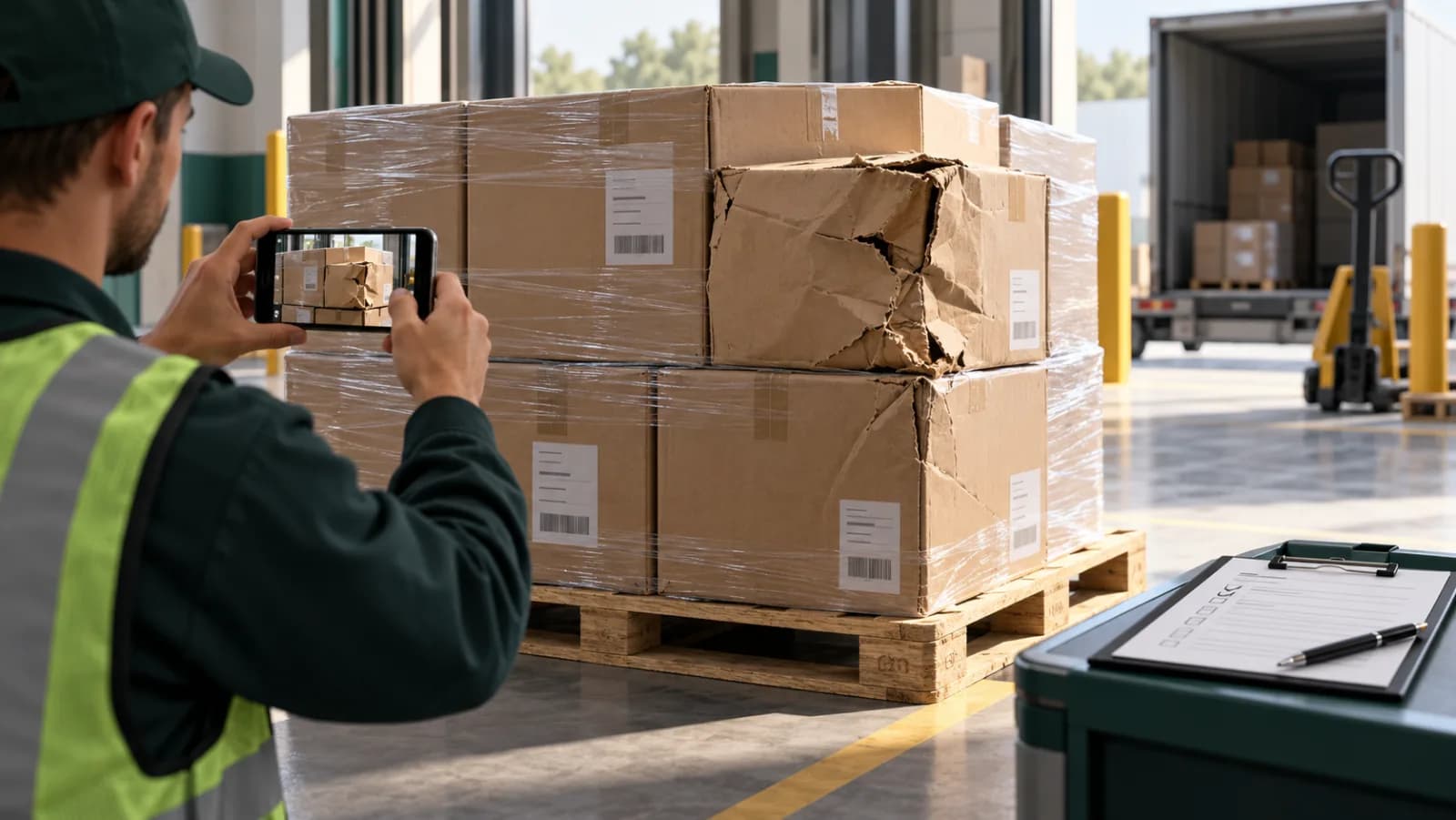
The receiving record shows the load as delivered, before unloading or opening: trailer and seal, the full load, labels, each damaged carton in context, and the count against the ASN. Visible exceptions are noted on the delivery receipt before the driver leaves. Cleverence recommends photo capture at exceptions with discrepancies documented before the truck leaves. Our receiving freight damage guide has the full procedure, and the receiving discrepancy report template standardizes the paperwork.
Storage: what happened while you held it
Storage records answer "was it damaged or lost in your building?" They include damage found during putaway, picking or counts, photographed where it was found, the quarantine location, and every inventory adjustment with who made it and why. The damaged inventory quarantine SOP covers the photos needed at each step.
Dispatch: what left, and how many
The dispatch record shows the goods as handed to the carrier: each pallet on all sides, wrap and labels, position in the trailer, doors closed, seal number, and the signed BOL with the piece count. Cleverence specifically recommends outbound photos or condition scans at the dock to counter "it was fine when it left" disputes. The shot list is in freight loadout photos.
Pickup count photos: the gap between dock and carrier
A pickup count photo is a single image, or a short clip, of the counted freight at the dock door with the driver's signed BOL showing the same piece count, taken at the moment of handoff. It closes the most common gap in lost-inventory disputes: freight that left the 3PL's dock but never arrived, or arrived short.
Without it, the brand says the goods were in the 3PL's custody and the carrier says it received fewer pieces. A signed BOL helps, but a driver signing for "12 pallets" while loading 11 is exactly the dispute paper cannot resolve.
The photo should show:
For parcel pickups, photograph the counted cartons or bags at handoff with the carrier's pickup manifest.
Step-by-step: handling a lost or damaged inventory claim
This procedure works from either side of the table, whether you are a brand asking for compensation or a 3PL responding to a claim.
Step 2 decides most claims. If the receiving record shows the damage at arrival, the claim moves to the carrier or supplier and the 3PL becomes a witness rather than a defendant. If the dispatch record shows a clean, counted handoff, the claim moves to the outbound carrier. Only when neither exists does the argument become a negotiation, and negotiations without records usually favor the client.
Copy-ready claim templates
A claim notice needs the units, dates, references and value basis. The three templates below cover the brand's notice, the 3PL's response and the carrier claim; adapt them to your contract's notice requirements.
How PallasMark documents custody at all three points
PallasMark gives a 3PL one record per custody moment, captured on the phones the team already carries and tied to the reference every party in a claim will quote.
Receiving, storage, loading and dispatch on one app. Warehouse records are tied to a shipment, pallet or lot reference, a facility and the client brand that owns the goods. The operator scans the label and the record opens under that reference, with custom fields for the PO, seal number, SKU or lot. On the Scale plan, AI label reading fills supplier, batch or lot, quantity, location, condition and your custom fields from a photo of the label, for the operator to review before saving; a scanned barcode always wins.
Sealed at upload. Every stored file gets a SHA-256 fingerprint, and a public verification page re-hashes the stored file on the spot. A brand, carrier or insurer can confirm the record has not changed without an account. There is no edit button for recordings.
Where it was captured. Each record notes whether it was captured inside the facility area, outside it, or not checked, and records are searchable by facility, client, date, condition, creator and custom fields, so the receiving record for lot 2291 is a search, not a hunt through someone's camera roll.
Shared one record at a time. Send a client brand, carrier or supplier a link to one record, with an expiry, an optional PIN and download settings, revocable at any time. They see that pallet or shipment and nothing else.
No hardware. No cameras to mount at dock doors, no per-station fees; the free plan needs no card. See warehouse proof, the warehouse solution and 3PL fulfillment, or compare plans on the pricing page.
For the full set of 3PL evidence moments and the disputes each one settles, see the 3PL evidence playbook. If a liability question is really about recurring count variance, start with 3PL shrinkage allowance benchmarks; if it is about what to write into the next agreement, see the 3PL contract evidence clause.
Frequently asked questions
Is a 3PL liable for damaged inventory?
In the U.S., a warehouse is liable for loss or damage caused by its failure to use the care a reasonably careful person would use, under UCC section 7-204, and it is generally not liable for damage that could not have been avoided with that care. The storage agreement can cap that liability. So a 3PL that damages stock through negligence in its own building usually pays, up to the contractual limit.
What are typical 3PL liability limits?
Common structures include a per-pound cap, per-occurrence and per-pallet caps, an annual aggregate, and a cap tied to a multiple of annual fees. As one published example, Uber Freight's standard warehouse terms cap liability at $0.50 per pound with a maximum of $50 per lot or $500 per shipment, unless the customer requests a higher valuation in writing, the warehouse consents in writing and an added charge applies. Shrinkage allowances, typically 0.5% to 1% of inventory, sit alongside these caps.
How do I get compensated when a 3PL loses my inventory?
Send a written claim inside the contract's notice window, identifying the units, the dates and the value basis, and ask the 3PL for its receiving and storage records for those units. If the loss is above the shrinkage allowance and the contract cap allows, the 3PL credits or reimburses. Claims without a receiving record proving the units arrived are the hardest to win, so check that first.
Who is responsible when freight arrives at the 3PL already damaged?
Usually the inbound carrier, if the damage was visible at delivery and noted on the delivery receipt, or the supplier, if sealed cartons arrived intact but short or badly packed. The 3PL's role is to document the condition before unloading and note exceptions before signing. A receipt signed clean shifts the argument toward the 3PL.
Does the 3PL's insurance cover my inventory at full value?
Not necessarily. Warehouse legal liability insurance typically responds when the 3PL was negligent, and it follows the contract's liability limits and the policy's sublimits, for example for theft or mysterious disappearance. Brands that want full-value protection usually buy their own stock and transit cover or declare a higher value in the storage agreement.
What evidence should a 3PL keep to defend a liability claim?
Three records per unit of custody: a receiving record showing condition and count against the ASN, storage records for damage, adjustments and counts, and a dispatch record showing condition and piece count at handoff to the carrier, including a pickup count photo with the signed BOL. Keep them at least as long as the longest claim window you face, tied to the PO, lot or BOL the other party will quote.
- 3pl
- warehouse liability
- lost inventory
- damaged goods
- freight claims
- chain of custody