Part of the Warehouse and 3PL evidence guide
Pick and pack quality control checklist with per-order proof


On this page
Printable resource
Pick and Pack Quality Control Checklist
A two-page, printable pick and pack QC record: order details, pick and pack checklists, a sampled re-inspection table and an error log with type and cause.
When to use this pick and pack checklist
Use this checklist when wrong sizes, colors or quantities keep reaching customers, or before they can. Typical moments: new packers, new SKUs or variants, peak season, onboarding a 3PL, or a client brand asking for your accuracy number in writing.
The problem is common and stubborn. One Shopify store owner with many variants described packers sending the wrong color, size or quantity despite several fixes, and wanted exactly this: scan the pick list, scan each product, flag any mismatch before the order ships. If a client claim has already arrived, start with 3PL mispick dispute evidence; this page is about stopping the next one.
The pick and pack quality control checklist
The checklist has four parts. Copy them, or download the printable version above.
1. Pick check
2. Pack check (every order)
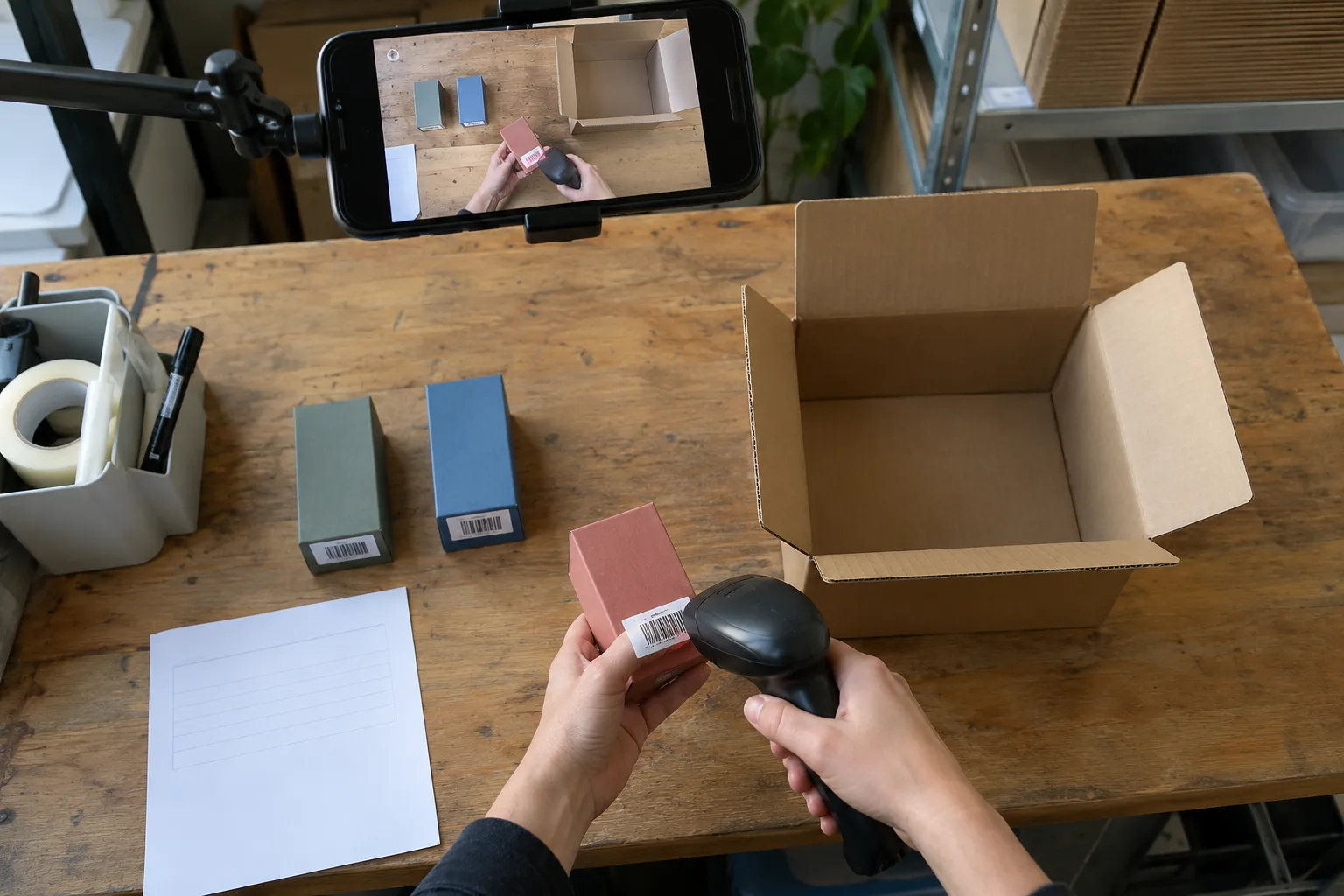
For the recording routine at the bench, use the packing station SOP template.
3. Sampled re-inspection
4. Error log (every error)
How to fill in the checklist
Fill it in at the moment each check happens, not at the end of the shift. The five steps below are the whole loop.
A per-order pack record makes step 3 checkable later:
What good looks like: order picking accuracy benchmarks
Best-in-class order-picking accuracy is 99.68% or higher, according to WERC's 2025 DC Measures report as summarized by report sponsor Yale. Most published benchmarks measure per order; one academic study measures per line.
| Benchmark | Value | Source |
|---|---|---|
| Best-in-class order-picking accuracy (2025) | ≥ 99.68% | WERC DC Measures 2025, via Yale's summary |
| Order picking accuracy, 2018: best-in-class / median / major opportunity | ≥ 99.9% / 99.3% / < 98% | WERC DC Measures 2018, via CSSI's infographic |
| Paper pick-list error rate in studied systems (per line) | ~0.3%, about 1 in 300 picked lines | TU München fml, 2012 |
| Perfect order index: median / top quartile | 90 / ≥ 95 | APQC via IndustryWeek, 2018 |
Yale's summary defines the metric as the accuracy of the picking process "where errors can be caught and corrected before shipment", so pack-bench catches count in your favor.
Pick one formula and write it in your SLA:
- Order accuracy = orders with no error ÷ orders checked.
- Line accuracy = correct lines ÷ lines checked.
They differ more than they look. As rough arithmetic, a 0.3% per-line error rate on a 4-line order means about 1.2% of orders have at least one error, assuming errors are independent. Inventory accuracy is a different number again; see 3PL shrinkage allowance benchmarks.
Why mispicks happen (and the fix for each)

Most mispicks are design problems, not careless people. The TU München study sorts picking errors into four types and groups causes under person, method, environment and other.
| Error type | What it means | Typical cause | Control |
|---|---|---|---|
| Wrong item | A wrong article instead of, or in addition to, the right one | Look-alike items stored side by side | Separate look-alikes; scan the item after the pick |
| Wrong quantity | Too many or too few of the right item | Miscounting under time pressure; small or tangling parts | Confirm quantity per line; count at pack |
| Omitted line | A line skipped (sometimes treated as quantity zero) | Confirming a step before doing it | No confirmation before the pick; scan each line |
| Condition | Wrong handling, such as damaged or mislabeled items | Rushed handling at pick or pack | Condition check before sealing |
The study names inattention, often driven by time pressure, and confirming process steps before carrying them out as recurring causes. It also recommends that similar-looking items are not stored next to each other, and notes that scanning the product barcode after the pick catches both type and quantity errors.
A broader review points the same way. Setayesh and colleagues found eight human-factor failure modes across 46 papers (physical workload, physical fatigue, mental fatigue, complexity, memory demand, vision, hearing and motivation), and interviews with 38 pickers at 14 companies added communication and supervision. Log the cause, not just the person, and fix the top cause first. Bad receiving is upstream of many mispicks; the receiving discrepancy report template covers that end.
Sample the inspection, record every order
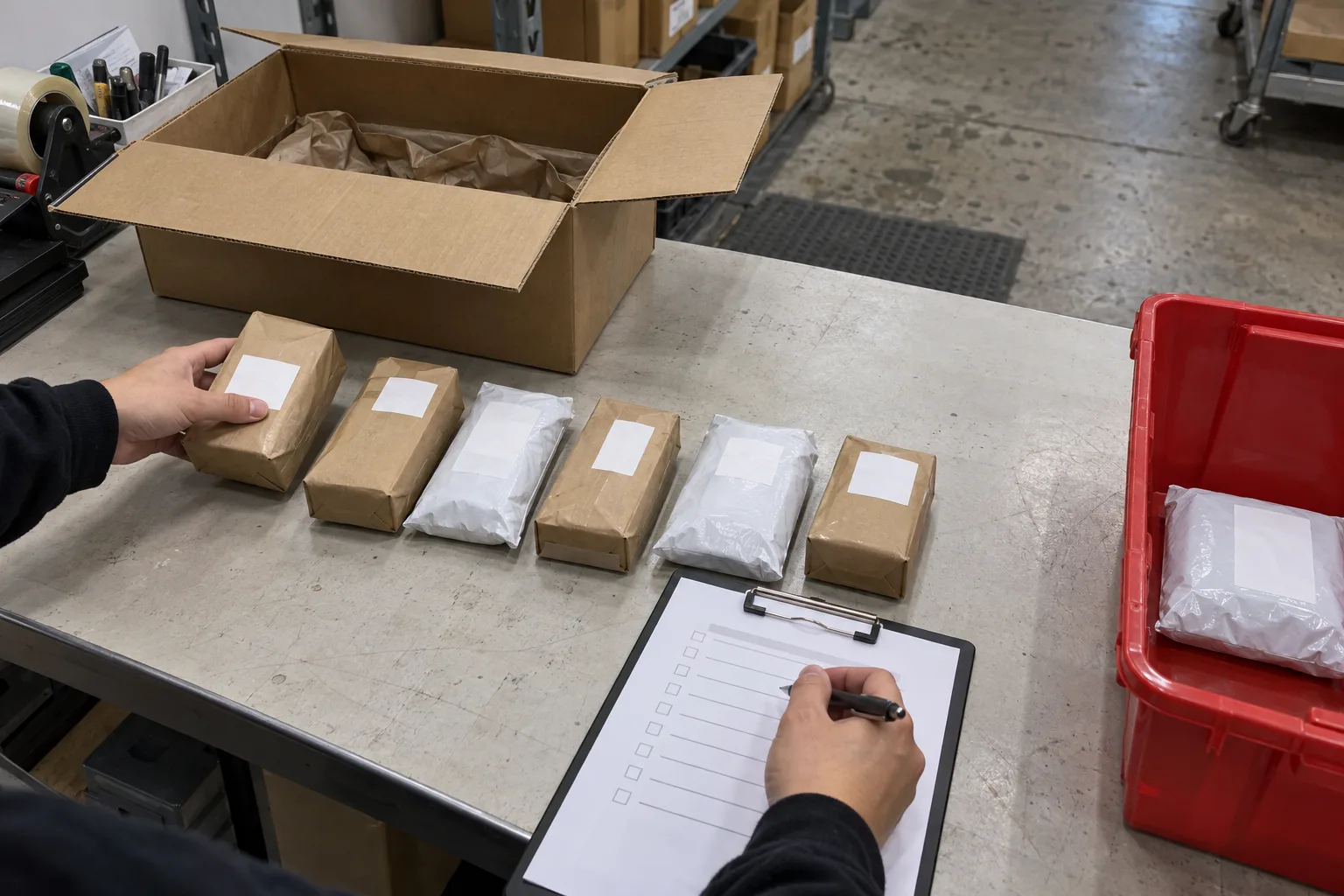
Inspection can be sampled; the record can't. A re-count of 1 order in 20 tells you your error rate, but only a record of every order tells you what happened to the one a customer complains about.
NIST describes acceptance sampling as "the middle of the road" between no inspection and 100% inspection, used to decide whether a lot is likely acceptable rather than to estimate its quality. The TU München paper adds that final checks, whether 100% or sampled, are reactive: a caught error means another pick. Scans at the bin and after the pick stop the error where it happens.
Catching it early is cheaper. In the same paper's small 2012 survey of companies, fixing an error found in an outbound sample check cost about €25, against about €210 on average when the customer found it. Scanning every unit added about 4 seconds per unit in its time study, so weigh where 100% scanning pays.
Turning QC into per-order proof
A QC checklist becomes evidence when each order leaves a record that ties the order number to the contents before sealing, who packed it and when. That record answers a "wrong item" complaint about one specific order, which no sample can.
What the recording itself must show is in the packing video evidence checklist. Get the camera close enough to read the label with the packing station camera setup guide, and for proving which unit shipped, see customer says wrong item sent.
How PallasMark digitizes pick and pack QC
PallasMark turns the pack check into a record your team creates on the phones they already hold.
- Filed under the order: the packer scans the barcode on the packing slip or shipping label and the app opens that order, so the video and photos of the contents before sealing belong to it from the first frame.
- Detectable if edited: every stored file gets a SHA-256 fingerprint and a public verification page that a client brand, buyer or carrier can open with no account. See tamper-proof video.
- Easy to find: warehouse records can be searched and filtered by facility, client brand, date, condition, creator and custom fields such as SKU or lot.
- Shared one record at a time: send a single warehouse record to a client brand through a link with an expiry and optional PIN, without opening the rest of the warehouse.
- Approved before dispatch: for high-value orders, the buyer watches the sealed recording and approves it before the parcel ships.
- Ready for a claim: on request, build an evidence PDF for the order with stills from the video, photos and fingerprints.
See packing quality control with video proof, warehouse proof and 3PL fulfillment. There is a free plan with no card; see pricing.
More warehouse evidence guides are in the 3PL evidence playbook, kitting teams should also read the subscription box QC checklist, and more printable templates are in free evidence templates.
Frequently asked questions
What is pick and pack quality control?
It is the set of checks that make sure each order leaves with the right items, quantities and condition: scans at pick and pack, a look at the contents before sealing, sampled re-inspection and an error log. Prevention happens at the scans; the sample measures how well they work.
What is a good order picking accuracy rate?
WERC's 2025 DC Measures report puts best-in-class order-picking accuracy at 99.68% or higher, as summarized by report sponsor Yale. In WERC's 2018 report the median was 99.3%. Always say whether you measure per order or per line, because the two numbers are not comparable.
How do you calculate picking accuracy?
Order accuracy is orders with no error divided by orders checked; line accuracy is correct lines divided by lines checked. A multi-line order counts as one error if any line is wrong. Measure with the same sampling method every week so the trend means something.
What causes mispicks?
A TU München study groups picking errors into wrong item, wrong quantity, omitted line and wrong condition. Causes it names include inattention under time pressure, confirming a line before it is picked, look-alike items stored side by side and small parts that tangle. Most are design problems, so fix the slotting or the process, not just the picker.
Should we inspect every order or a sample?
Re-inspect a sample, and put 100% checks on new packers, new SKUs, high-value orders and SKUs with recent errors. Sampling tells you your error rate, but it can't tell you what happened in one specific order. That is why a per-order record of the contents before sealing is worth keeping for every order.
Does packing video replace barcode scan verification?
No. A scan stops a wrong item before the box closes; a recording shows what went in and when. Use both: the scan prevents the error, and the record settles the complaint and shows the root cause.
How can a small brand reduce pick and pack errors without a WMS?
Print the order barcode on the packing slip, scan it to open the order at the bench, check each item and variant against the order before sealing, and keep a photo or video of the contents. Log every error by type for a month and fix the top cause first.
- pick and pack quality control
- order picking accuracy
- mispicks
- warehouse quality control checklist
- fulfillment qa
- templates